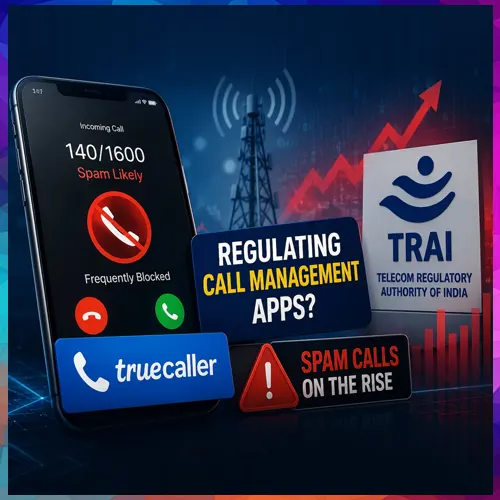
India's telecom regulator has barred apps like Truecaller from marking calls as spam unless reports feed into the operator-run DLT platform, and also shielded 1600 and 140 series calls from being blocked, filtered or tagged.
India's telecom regulator has tightened the rulebook for call management apps such as Truecaller, ruling that they cannot let users label a call as spam or junk unless that report is also shared with the Distributed Ledger Technology (DLT) platform maintained by telecom operators. The Telecom Regulatory Authority of India (TRAI) announced the measures on Friday, 18 September.
The regulator has also barred these apps from blocking, filtering or tagging as spam any call that originates from the 1600 and 140 number series. Taken together, the two changes limit how far third-party apps can act on their own when deciding which calls consumers should treat with suspicion, and they tie spam labelling more closely to the operators' shared platform.
For users, the practical effect appears to be that spam warnings shown by such apps will need to be backed by reports that also reach the operator-run system, rather than resting on crowd-sourced flags alone. For the apps, it adds a compliance requirement to a feature that many users rely on.
Spotlight on Truecaller and similar apps
The move matters most for services like Truecaller. The company had earlier said that its users flagged a number of calls from the 1600 and 140 series as spam. It has also said it complied with previous directions to unblock calls from those series. Even so, it introduced a badge that marked such calls using feedback from its users. Under the latest rules, tagging calls from these series as spam is no longer permitted, whatever the source of the flag.
The announcement forms part of a wider push by TRAI to strengthen regulations against spam calls and messages, and to tighten controls on commercial communication so that consumers face fewer unwanted calls and texts.
Shorter windows and robocall curbs
Other provisions target marketing outreach. Commercial communication that follows a consumer's inquiry about a product or service will be allowed for only seven days from the date of that inquiry, after which businesses can no longer contact the person on that basis.
The regulator has also set new conditions for automated calls. Every robocall that uses a pre-recorded voice message must carry a "pre-declaration", and automated calls lacking one will be treated as spam. To discourage such calls further, TRAI has introduced a termination charge of ₹0.05 per call.
Together, the measures point to a regulator intent on routing spam control through a common, operator-backed framework, with clearer limits on what apps, marketers and automated dialling systems may do. TRAI's stated aim is to keep commercial communication within defined boundaries and to reduce the volume of unwanted calls and messages that reach consumers, and the new rules extend that effort to the apps many people use to screen their calls.