
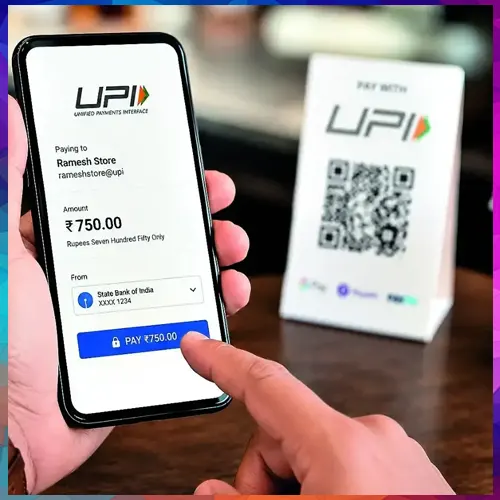
The government has clarified that consumers and person-to-person UPI payments will remain free, while any future merchant charge would be limited to select high-value transactions and set well below card payment rates.
The government has assured users that UPI transactions will continue to remain free for consumers, even as it considers allowing a nominal Merchant Discount Rate (MDR) on a limited category of merchant payments above a specified threshold.
The Ministry of Finance said on Saturday (August 8) that any MDR introduced in the future would not apply universally to UPI merchant transactions. Instead, the proposed framework would target only a limited set of transactions crossing a predetermined value, with charges kept substantially below those applicable to debit and credit card payments.
The clarification comes amid discussion around proposed changes to the country's digital payments framework. The government said the proposed move should not be interpreted as an immediate introduction of charges on UPI transactions.
No charges for consumers or P2P payments
According to the Finance Ministry, the vast majority of UPI transactions would continue to be free for merchants. Any MDR, if eventually introduced, would be based on a transaction threshold rather than imposed as a blanket charge across the UPI ecosystem.
The government has particularly stressed that consumers will not have to pay for using UPI. Person-to-person transactions will also remain free, ensuring that routine transfers between individuals are outside the scope of any potential MDR framework.
The proposed approach is linked to the Taxation and Other Laws (Amendment) Bill, 2026, which seeks to amend Section 10A of the Payment and Settlement Systems Act, 2007. If Parliament approves the legislation, the UPI and Services Steering Committee, headed by the National Payments Corporation of India (NPCI), would determine whether MDR should be introduced and how it would be structured.
Government seeks sustainable digital payments model
The Finance Ministry said the enormous growth in UPI usage has created a continuing need for investment in areas such as cybersecurity, fraud prevention and payment infrastructure. Maintaining the scale and reliability of the network requires a sustainable financial model, it said.
The government also believes a predictable revenue mechanism could encourage more businesses to invest in India's digital payments ecosystem. It argued that depending entirely on subsidies may not be sufficient to support the next phase of UPI's expansion.
The proposed amendment is therefore being positioned as an enabling provision aimed at creating a sustainable and future-ready digital payments infrastructure, rather than as a move to make UPI costly for ordinary users.
The government has also dismissed reports that external pressure or influence prompted the proposed policy change, describing such claims as "unfounded, completely false and misleading."
For consumers, the key takeaway remains that UPI payments will continue to be free. Any future MDR would be confined to selected merchant transactions above a defined threshold and would be substantially lower than comparable debit and credit card charges.