

By Mr.Roshan Kumar Sahu, Ex-Co-founder, FaceOff Technologies
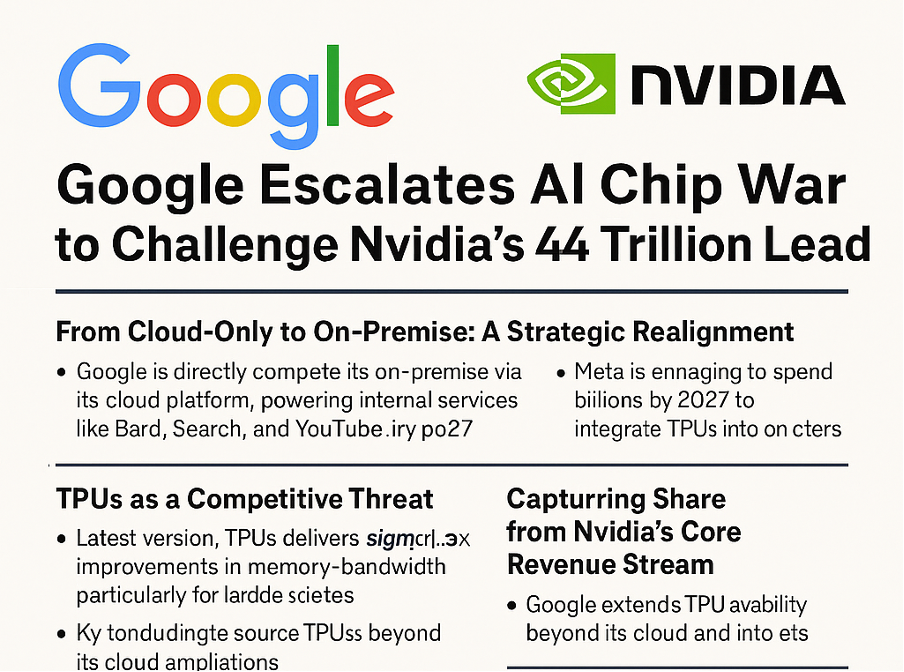
In a pivotal shift in the landscape of artificial intelligence infrastructure, Google is making aggressive moves to challenge Nvidia’s $4 trillion dominance in the AI chip market. Known primarily for its leadership in cloud services, search, and software, Google is now extending its reach into hardware with an ambitious strategy centered on its custom-built Tensor Processing Units (TPUs). The goal: directly compete with Nvidia's highly sought-after AI GPUs and establish a meaningful foothold in the most lucrative layer of the AI value chain.
From Cloud-Only to On-Premise: A Strategic Realignment
Until recently, Google’s TPUs were accessible only via its cloud platform, powering internal services like Bard, Search, and YouTube, while also serving cloud customers with large-scale AI workloads. However, the company is now pivoting to a hybrid deployment strategy, actively pitching the idea of on-premise TPU infrastructure to major enterprise clients. According to sources, Meta is in discussions to spend billions by 2027 to integrate TPUs into its own data centers, signaling a possible shift away from near-total reliance on Nvidia GPUs.
This change not only broadens Google's addressable market but also aligns with enterprise clients' growing interest in infrastructure flexibility—particularly as training AI models becomes increasingly expensive and latency-sensitive.
TPUs as a Competitive Threat
Google's custom TPUs have matured across several generations and now rival traditional GPUs in performance, particularly for large-scale machine learning workloads. The latest version, TPU v5p, delivers significant improvements in memory bandwidth, parallelism, and power efficiency. It’s tailored for tasks such as training foundation models and running inference pipelines at scale—domains historically dominated by Nvidia’s A100 and H100 GPUs.
That Meta is exploring TPUs for training new foundational AI models is a strong signal that Google has closed much of the technical gap. For an enterprise of Meta’s scale to even consider such a shift suggests performance benchmarks are becoming comparable, and Google's software ecosystem—once seen as a weakness—is reaching functional maturity.
Capturing Share from Nvidia’s Core Revenue Stream
Within Google Cloud, senior executives believe the company could ultimately capture up to 10% of Nvidia’s annual AI chip revenue. That would be a significant disruption in a market where Nvidia is projected to generate over $50 billion annually from AI hardware alone in the coming years.
By extending TPU availability beyond its cloud and into enterprise-controlled environments, Google introduces a new form of competition: cloud-independent custom silicon, tailored to specific workloads but integrated seamlessly into hybrid architectures. This model gives clients more control over data sovereignty, compliance, and infrastructure optimization, while offering Google new revenue paths.
Owning the Full Stack
A key advantage Google holds is its ability to control the entire AI stack. From designing silicon and managing data centers to building AI models like Gemini and embedding them into services like Search and Ads, Google operates across all layers. This vertical integration enables optimization at a granular level—delivering faster model inference, lower training costs, and more efficient resource allocation.
This approach contrasts sharply with Nvidia, which primarily sells chips to cloud providers and hardware OEMs, relying on partnerships rather than direct ownership of full-stack deployment.
The Silent Expansion of Google’s AI Hardware Ambitions
While much of the focus in the AI hardware race has been on Nvidia, Google's progress has been more quiet but consistent. Behind the scenes, it has continued to roll out advanced AI chips, invest in data center expansion, and push the TPU roadmap forward. The company has shown a clear intention to reduce reliance on third-party chipmakers and secure its AI infrastructure from the ground up.
This strategy is not just about competing on performance—it’s also a response to the hardware supply constraints and pricing volatility associated with Nvidia’s GPUs, which are often in short supply during AI booms. By building its own chips, Google gains predictability in cost and scale, which it can pass on to customers.
Competitive Landscape: A Growing Chorus of Rivals
Google is not alone in its efforts to challenge Nvidia. Microsoft has introduced its Azure Maia AI chips, Amazon has rolled out Trainium and Inferentia, and Meta is rumored to be developing its own accelerators as well. These hyperscalers are increasingly investing in custom silicon to reduce dependency, control costs, and tailor performance to their platforms.
The collective aim is not necessarily to dethrone Nvidia overnight but to build credible alternatives that give customers choice and insulate the hyperscalers from supply chain and pricing risks.
Jensen Huang’s Moat Under Pressure
Nvidia CEO Jensen Huang has long maintained that the company’s true advantage lies in its software ecosystem—particularly CUDA, which powers a vast portion of AI development globally. This ecosystem lock-in has made it difficult for competitors to lure developers away, even when hardware parity is achieved.
However, Google’s advances suggest that the moat may be narrowing. If more enterprises adopt TPUs, Google’s software compatibility, developer tools, and support ecosystem will only grow stronger. Over time, this could weaken CUDA's dominance and erode the switching costs that have historically kept Nvidia at the center of AI development.
Not Just Chips—The Future of AI Infrastructure
This battle isn't merely about who builds the fastest chips—it’s about who controls the future of enterprise AI infrastructure. As organizations scale their AI ambitions, the need for cost-effective, high-performance compute solutions becomes critical. Enterprises are demanding more flexible, modular, and open systems that can span across cloud and on-prem environments.
Google’s push to offer TPUs beyond its cloud walls reflects this new reality. It positions the company as a long-term AI infrastructure partner—not just a cloud vendor, but a provider of deep technical solutions for training, inference, and system-level AI optimization.
Challenges Ahead: Adoption, Ecosystem, and Flexibility
Despite its momentum, Google faces notable hurdles. TPUs lack the widespread developer base that Nvidia enjoys, and adapting existing models to TPU architecture still requires technical effort. Enterprises deeply invested in CUDA may be reluctant to shift unless the performance gains or cost reductions are dramatic.
Additionally, Google's chips have been closely tied to its proprietary infrastructure. While the new strategy promises broader deployment options, questions remain about how open or portable these solutions will be—particularly in environments demanding multi-cloud or hybrid compatibility.
Conclusion: Strategic Positioning for the Long Game
Google’s efforts to break into Nvidia’s AI chip stronghold represent a long-term strategic move, not a short-term market disruption. It is building the foundations of a new kind of AI ecosystem—one where cloud platforms not only host AI workloads but power them with custom hardware designed in-house.
The move to offer TPUs for on-premise deployment reflects a broader vision: that the future of AI will require customization, flexibility, and ownership of every layer of the stack. Google, by leveraging its scale, engineering depth, and product ecosystem, is positioning itself to be a formidable player in this next phase of the AI race.
Nvidia remains the leader today, but its monopoly is no longer absolute. The AI chip war is heating up—and Google is no longer fighting from the sidelines.

See What’s Next in Tech With the Fast Forward Newsletter









Tweets From @varindiamag
Nothing to see here - yet
When they Tweet, their Tweets will show up here.