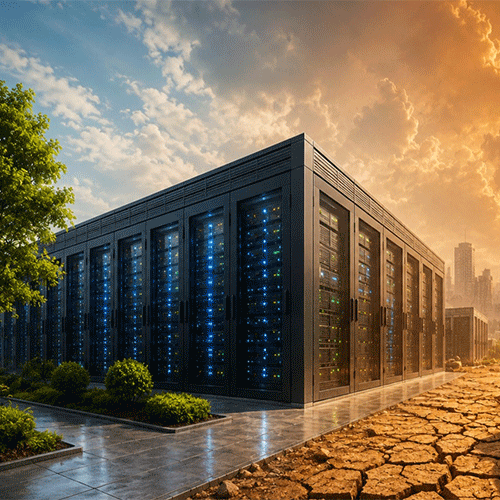
India's ambition to become a global Artificial Intelligence powerhouse is colliding with an uncomfortable reality—AI infrastructure comes at an enormous environmental and social cost. The latest flashpoint is Amazon's proposed ₹45,000-crore data centre in Thane, Maharashtra, where hundreds of residents have protested against the project, citing concerns over electricity consumption, water use, noise pollution, and its impact on surrounding communities. Protesters claim the 53-acre facility could require massive amounts of electricity and significant water resources, while raising fears of heat and noise in a densely populated residential zone.
Amazon has strongly rejected several of these allegations, stating that the Thane facility complies with all environmental regulations, will not use potable water for cooling, and has approval for only a minimal water supply intended for drinking and sanitation. The company also says the project will rely on dedicated infrastructure rather than drawing from community utility resources.
The controversy highlights a much larger issue that extends far beyond one project. Artificial Intelligence has fundamentally changed the economics of data centres. Unlike traditional cloud infrastructure, AI data centres operate thousands of high-performance GPUs that consume several times more electricity, generate enormous heat, and require sophisticated cooling systems. As governments compete to attract AI investments, communities around the world are increasingly questioning whether the local environmental costs justify the promised economic benefits.
India finds itself at a critical crossroads. The country wants to become a global AI hub under initiatives such as the IndiaAI Mission while simultaneously pursuing ambitious renewable energy and climate commitments. Yet AI infrastructure is expected to become one of the fastest-growing consumers of electricity over the next decade. Without parallel investments in clean power generation, transmission infrastructure, energy storage, and sustainable cooling technologies, the AI boom could place unprecedented stress on urban utilities.
The Thane protests also expose a growing governance challenge. Citizens are no longer questioning digital transformation itself—they are demanding transparency over its hidden costs. Communities want independent environmental assessments, disclosure of power and water consumption, heat and noise mitigation plans, and meaningful public consultation before mega data-centre projects receive approval. Digital infrastructure is increasingly becoming public infrastructure, carrying obligations that extend beyond commercial returns.
The Thane episode reflects a global shift in public perception. Across the United States, Europe, and parts of Asia, AI-driven data centres are encountering growing resistance over land acquisition, electricity demand, groundwater usage, diesel backup generators, and carbon emissions. As AI adoption accelerates, the debate is no longer about whether more data centres are needed, but where they should be built, how they should be powered, and who bears the environmental burden.
For technology companies, the challenge is equally strategic. Building the next generation of AI infrastructure will require more than capital investment—it will require social licence to operate. Renewable-powered campuses, closed-loop cooling systems, waste-heat recovery, transparent ESG reporting, and community engagement are rapidly becoming competitive differentiators rather than optional sustainability initiatives.
The irony is striking. AI promises to solve some of humanity's biggest challenges—from climate modelling and healthcare to energy optimization and smart cities. Yet the infrastructure powering this revolution risks creating new pressures on electricity grids, water resources, and local ecosystems if growth outpaces sustainability. Moving from the "frying pan into the fire" would mean solving one technological challenge while creating another environmental crisis.
The future of AI will therefore be determined not only by faster chips and larger models, but also by the industry's ability to build energy-efficient, water-conscious, and community-friendly digital infrastructure. In the age of AI, sustainable data centres are no longer an environmental aspiration—they are a strategic necessity.

See What’s Next in Tech With the Fast Forward Newsletter









Tweets From @varindiamag
Nothing to see here - yet
When they Tweet, their Tweets will show up here.