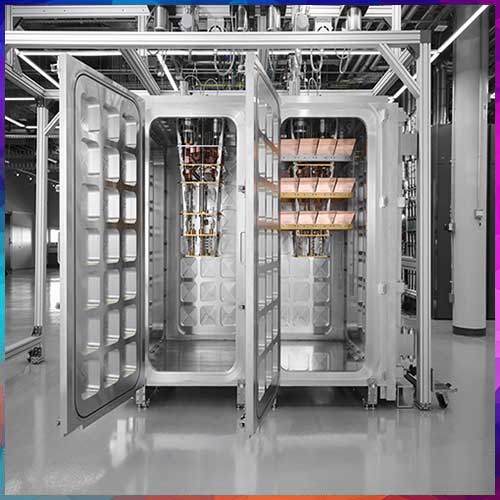
IBM has connected and cooled two cryogenic modules within a shared environment, marking progress toward a scalable quantum system that could link hundreds of processors and support the company’s planned 2029 fault-tolerant quantum computer.
IBM has announced a key hardware development in its quantum computing programme, successfully connecting two cryogenic modules and operating them together in a single environment. The architecture is being developed to support larger quantum systems capable of connecting multiple quantum processors and tackling increasingly complex computational problems.
The development forms part of IBM’s roadmap toward IBM Quantum Starling, which the company plans to deliver in 2029. IBM expects Starling to become a fault-tolerant quantum computer by combining advances in quantum error correction, processor design, decoding and systems engineering.
New architecture targets larger quantum systems
The two operational modules together stand more than eight feet tall and eight feet wide. During initial testing, the connected system reached 4 Kelvin, roughly the temperature associated with liquid helium, in less than five days. The modules subsequently achieved a final temperature below 15 millikelvin.
Each module’s vacuum enclosure provides up to 12 times more wiring capacity than the enclosures used in many of IBM’s widely deployed quantum systems. The additional space is intended to support a greater number of connections between quantum chips, both within individual modules and across multiple modules.
IBM has adopted a box-shaped design that allows the cryogenic units to be positioned closely together in a row. This configuration provides space for IBM’s L-coupler technology, which is designed to connect separate quantum processors so they can exchange information and operate collectively as part of a larger computing system.
“Bringing fault-tolerant quantum computers to industries depends on several fundamental advances,” said Jay Gambetta, Director of IBM Research and IBM Fellow. “The successful connection and operation of these cryogenic modules signals a leap forward in that direction and will accelerate our progress alongside continued innovation in quantum hardware, software, and algorithms.”
IBM targets 1,000 programmable qubits by 2027
IBM’s quantum computing roadmap calls for L-couplers to be used by 2027 to connect multiple processors into a larger system containing at least 1,000 programmable qubits. These are qubits that can be directly used to perform computational operations.
As part of this development effort, IBM plans to install its Quantum Nighthawk processors into the cryogenic modules later this year. The company will use the setup to conduct expanded testing of system performance and the interaction between multiple quantum processors.
IBM expects each cryogenic module to accommodate thousands of qubits by the time Quantum Starling is delivered. Achieving this scale will require advances not only in processors but also in the surrounding infrastructure needed to operate quantum systems at extremely low temperatures.
The company introduced its Starling plans last year alongside a new quantum error-correction approach designed to reduce the physical resources needed to achieve fault-tolerant computing. Since then, IBM says it has continued to demonstrate key hardware components and improve the efficiency of quantum error-correction decoding.
The new cryogenic architecture also incorporates three essential elements of the environment used in IBM Quantum System Two. However, IBM has redesigned the architecture so individual components can be tested, upgraded and refined independently.
IBM views the successful integration of the two cryogenic modules as another step toward overcoming the hardware and systems challenges associated with scaling quantum computers. The company says the development will support faster testing and iteration as it works toward its longer-term goal of fault-tolerant quantum computing.

See What’s Next in Tech With the Fast Forward Newsletter








Tweets From @varindiamag
Nothing to see here - yet
When they Tweet, their Tweets will show up here.