

MIT develops Paper-thin loudspeaker
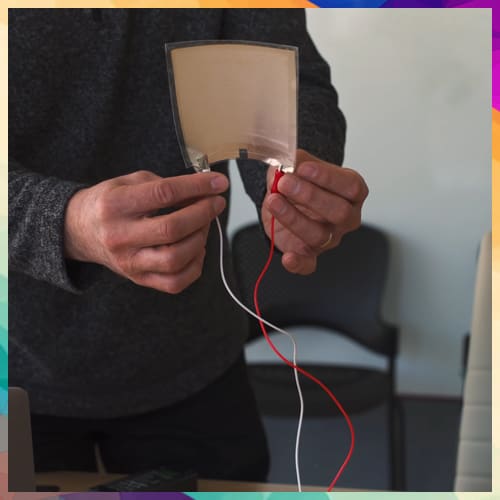
The Massachusetts Institute of Technology’s (MIT) engineers have developed a paper-thin loudspeaker that can turn any surface into an active audio source. The device weighs just 2 grams and is the size of a human hand.
This thin-film loudspeaker produces sound with minimal distortion while using a fraction of the energy required by a traditional loudspeaker. The loudspeaker can generate high-quality sound no matter what surface the film is bonded to.
The thin-film loudspeaker could provide active noise cancellation in clamorous environments, such as an airplane cockpit, by generating sound of the same amplitude but opposite phase. The flexible device could also be used for immersive entertainment, perhaps by providing three-dimensional audio in a theatre or theme park ride. The device is well-suited for applications on smart devices where battery life is limited, as it is lightweight and requires such a small amount of power to operate.
For building the loudspeaker, the researchers used a laser to cut tiny holes into a thin sheet of PET, which is a type of lightweight plastic. They laminated the underside of that perforated PET layer with a very thin film of piezoelectric material, called PVDF. Then they applied vacuum above the bonded sheets and a heat source, at 80 degrees Celsius, underneath them.
The pressure difference created by the vacuum and heat source caused it to bulge as the PVDF layer is so thin. The PVDF can’t force its way through the PET layer, so tiny domes protrude in areas where they aren’t blocked by PET. These protrusions self-align with the holes in the PET layer. The researchers then laminate the other side of the PVDF with another PET layer to act as a spacer between the domes and the bonding surface.
The energy-efficient device only requires about 100 milliwatts of power per square meter of speaker area. The loudspeaker has a high enough resonance frequency that it can be used effectively for ultrasound applications, like imaging.
Vladimir Bulović, the Fariborz Maseeh Chair in Emerging Technology, Leader of the Organic and Nanostructured Electronics Laboratory (ONE Lab), Director of MIT.nano, and Senior Author of the paper, said, “It feels remarkable to take what looks like a slender sheet of paper, attach two clips to it, plug it into the headphone port of your computer, and start hearing sounds emanating from it. It can be used anywhere. One just needs a smidgeon of electrical power to run it.”
The device could also use ultrasound to detect where a human is standing in a room, just like bats do using echolocation, and then shape the sound waves to follow the person as they move, Bulović explains.

See What’s Next in Tech With the Fast Forward Newsletter








Tweets From @varindiamag
Nothing to see here - yet
When they Tweet, their Tweets will show up here.