
The foundations of modern digital security—RSA, ECC, Diffie–Hellman, and even HSM-protected key systems—are built on the belief that certain mathematical problems are too hard to solve in any reasonable time. For decades, this assumption held firm. But the rise of Quantum Neuro-Cryptography (QNC) is reshaping that reality at unprecedented speed.
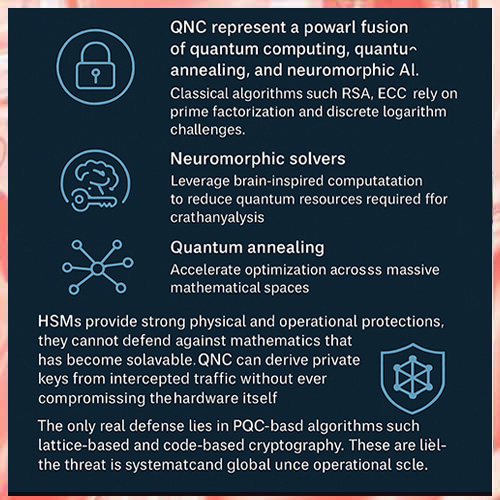
QNC represents a powerful fusion of quantum computing, quantum annealing, and neuromorphic AI. Together, these technologies accelerate the solving of mathematical problems once considered practically impossible.
Classical algorithms such as RSA, ECC, and DH rely on prime factorization and discrete logarithm challenges. While these are difficult for traditional computers, QNC dramatically weakens their security foundations.
Shor’s Algorithm, a well-known quantum breakthrough, can factor large primes exponentially faster than classical systems. QNC advances this even further by integrating quantum-enhanced neural networks that learn factorization patterns and anticipate prime structures.
Neuromorphic solvers leverage brain-inspired computation to reduce quantum resources required for cryptanalysis. This reduces the time and energy needed to break large keys that once seemed unassailable.
Quantum annealing accelerates optimization across massive mathematical spaces, enabling faster attacks on discrete logarithm and elliptic-curve systems. As these techniques mature, attacks that once required centuries can be executed in minutes.
While HSMs provide strong physical and operational protections, they cannot defend against mathematics that has become solvable. QNC can derive private keys from intercepted traffic without ever compromising the hardware itself.
This means encryption systems widely used in banking, telecom, identity infrastructure, and cloud platforms will fail once practical QNC systems emerge. The threat is systemic and global.
QNC also lowers the qubit threshold traditionally required for quantum attacks through neural approximation and quantum-inspired optimization.
The only real defense lies in quantum-secure, PQC-based algorithms such as lattice-based and code-based cryptography. These are currently the best foundations for resilience in a quantum-AI era.
The transition to PQC is no longer optional. Organizations that delay migration risk catastrophic exposure once QNC reaches operational scale.

See What’s Next in Tech With the Fast Forward Newsletter





Tweets From @varindiamag
Nothing to see here - yet
When they Tweet, their Tweets will show up here.