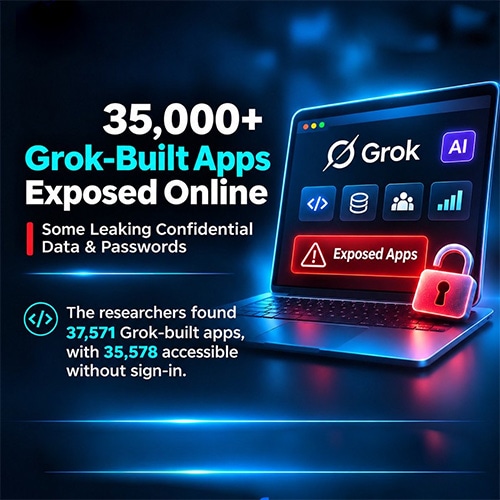
A major security discovery has raised concerns over AI-generated applications after researchers at cybersecurity firm Claroc identified 37,571 Grok-built apps accessible online, potentially exposing sensitive business information and confidential data.
According to the researchers, 35,578 applications were publicly accessible without requiring authentication, highlighting serious weaknesses in access controls and security practices surrounding AI-assisted software development.
The exposed applications reportedly included 24 developed by employees of X, the social media platform associated with Elon Musk's AI ecosystem, raising questions about internal governance and application security.
Some applications allegedly contained confidential information, passwords and other sensitive data, demonstrating how quickly AI-generated software can become a cybersecurity liability when deployed without adequate safeguards.
The findings underscore a growing challenge: AI coding assistants enable users to build applications rapidly, but security configurations, authentication mechanisms and data protection controls may receive insufficient attention.
Unlike traditional software development, where security reviews often involve dedicated engineering teams, AI-assisted development can encourage inexperienced users to deploy functional applications without understanding their underlying vulnerabilities.
The biggest concern is the emergence of shadow AI development, where employees independently create applications that interact with corporate information, potentially bypassing established security policies and approval processes.
Such exposures could allow cybercriminals to discover credentials, access internal systems, harvest sensitive information or exploit poorly secured application interfaces for further attacks.
For enterprises, the incident reinforces the importance of implementing zero-trust security, automated vulnerability scanning, secrets management and continuous monitoring across AI-generated applications.
Security experts increasingly advocate mandatory authentication, least-privilege access, secure coding validation and human oversight before AI-built applications are deployed into production environments.
The larger lesson is clear: AI can accelerate software innovation, but speed without security creates systemic risk.As autonomous coding tools become mainstream, organizations must ensure that AI-generated applications meet the same rigorous security, privacy and governance standards as traditionally developed software.