........ the Invisible Engine Behind Every Uber Ride
Imagine stepping out of a crowded airport and booking an Uber. Within seconds, the application identifies nearby drivers, estimates waiting times and calculates your fare.
SUNDAY, 29 NOVEMBER 2026


........ the Invisible Engine Behind Every Uber Ride
Imagine stepping out of a crowded airport and booking an Uber. Within seconds, the application identifies nearby drivers, estimates waiting times and calculates your fare.
Behind this seemingly simple experience lies a sophisticated real-time architecture that transforms millions of location signals into actionable intelligence.
Every few seconds, drivers transmit GPS coordinates, feeding a continuous stream of location data that helps Uber visualize driver availability across cities.
The intelligence begins with H3 geospatial indexing, which divides the Earth's surface into hierarchical, predominantly hexagonal cells, enabling efficient spatial searches and driver density calculations.
Unlike conventional square grids, hexagonal indexing provides more uniform distances between neighboring cell centers, supporting smoother geographical analysis and marketplace decisions.
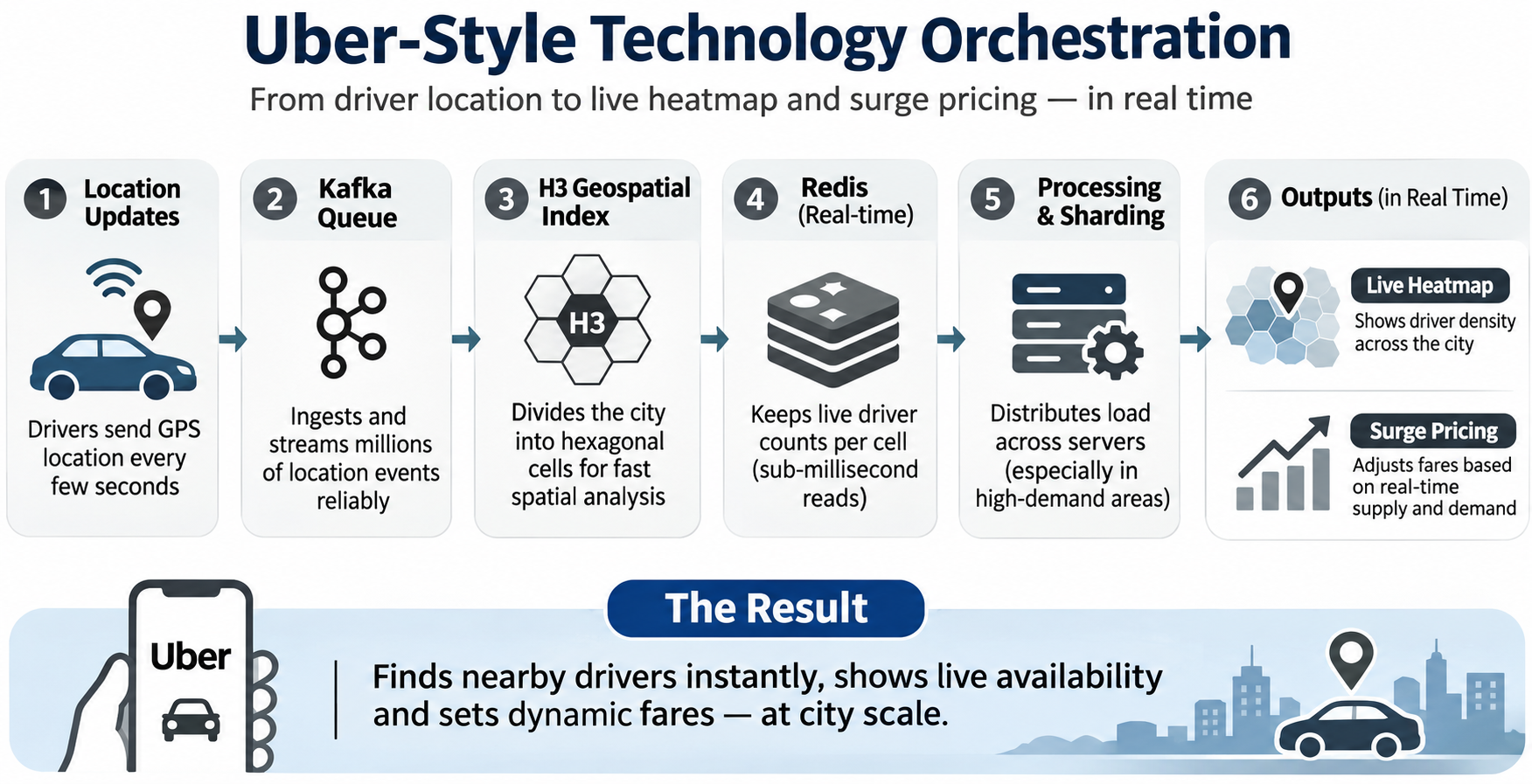
Managing enormous volumes of location updates requires robust infrastructure. Apache Kafka serves as the event-streaming backbone, separating data ingestion from processing and supporting scalability.
Redis, an in-memory data platform, enables rapid driver-density calculations through real-time counters, helping the system maintain an updated view of vehicle availability.
During concerts, sporting events or airport rush hours, sharding techniques distribute computational workloads, preventing localized demand spikes from overwhelming individual servers.
The surge pricing engine analyzes geographical supply-demand imbalances, dynamically adjusting fares to encourage driver availability and maintain marketplace efficiency.
Together, geospatial indexing, event streaming, distributed computing and real-time caching transform raw GPS coordinates into meaningful, city-scale operational intelligence.
Ultimately, Uber's competitive advantage extends beyond transportation. It demonstrates how intelligent software architecture can orchestrate physical resources at enormous scale, turning location data into commercial value. Every ride is not merely a journey between two destinations—it is the outcome of a sophisticated, continuously evolving digital intelligence ecosystem.
Loading comments…
Share your thoughts on this story. Comments are moderated before they appear.
Be respectful. Comments are reviewed before publication, and spam or abusive language will be removed.
Keep reading

CSR Initiatives
10 April 2020

Cyber Crime
23 November 2026

Round About
29 November 2026

Round About
27 November 2026