
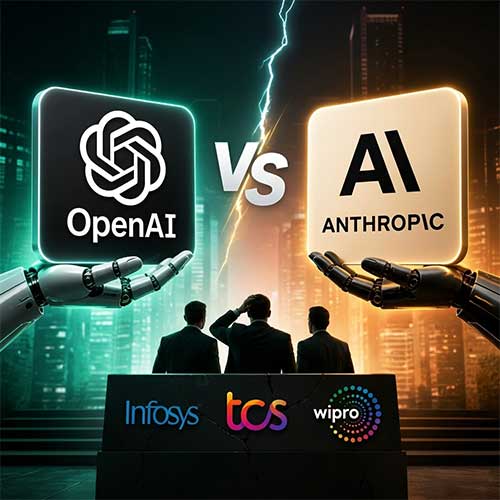
The global AI services landscape shifted dramatically on May 4, 2026, as Anthropic and OpenAI transitioned from model providers to full-service AI integrators. By launching dedicated services arms, these AI pioneers are moving beyond software licensing to direct enterprise deployment. This strategic pivot places them in a complex relationship with Indian IT giants like Infosys and TCS, who have long dominated the technology services sector.
Anthropic has partnered with a powerhouse consortium including Blackstone, Goldman Sachs, and Hellman & Friedman to form a $1.5 billion AI services venture. This entity targets mid-sized companies in healthcare, finance, and manufacturing. By utilizing "forward-deployed engineers," Anthropic aims to embed its Claude models and agentic systems directly into client workflows, automating complex compliance and operational tasks.
Simultaneously, OpenAI unveiled "The Deployment Company" (DeployCo), valued at $10 billion with over $4 billion in capital from investors like Brookfield and TPG. OpenAI retains majority control of this venture, which focuses on scaling Codex and ChatGPT Enterprise. These initiatives mirror the high-touch engineering models utilized by firms like Palantir, aiming to accelerate AI adoption across vast private equity portfolios.
For India’s IT powerhouses, these moves present a dual reality of competition and collaboration. Infosys has already integrated Claude models into its Topaz platform, establishing a dedicated Center of Excellence for AI agents. Meanwhile, TCS has aligned with OpenAI to leverage Codex and its proprietary HyperVault data centers, positioning itself as a vital delivery partner for OpenAI’s large-scale infrastructure needs.
Anthropic is poised to challenge India's IT services sector with its new AI services venture. Announced plans to integrate its AI model, Claude, into critical operations of mid-sized companies across various industries. This move directly positions Anthropic against major Indian IT firms such as Tata Consultancy Services (TCS), HCL Technologies, Infosys, and Wipro. Industry experts indicate that while these companies are unlikely to lose a significant portion of their clients, management will face pressure to renegotiate terms regarding AI implementation and usage.
The "Bull Case" for AI suggests that autonomous agents could automate core software maintenance and business processes, allowing OpenAI and Anthropic to bypass traditional IT intermediaries for mid-market projects. This potential for direct deployment has already triggered market volatility as investors weigh the threat of AI-led automation.
However, new AI entrants face formidable "gritty realities," including fragmented legacy systems, strict data security mandates, and complex regulatory compliance. Pure-play AI firms often lack the massive scale and decades of domain expertise required to navigate these hurdles—areas where established integrators like TCS and Infosys excel.
Critics argue that total displacement is "daydreaming," viewing AI instead as a force multiplier that augments human talent. Furthermore, intense scrutiny regarding data sovereignty—exemplified by U.S. Pentagon concerns and the EU AI Act—could slow aggressive expansion. Ultimately, the success of these AI firms may depend on their integration into the existing ecosystem rather than their ability to disrupt it. By pivoting toward higher-value AI services, the Indian IT model can leverage these frontier models as growth accelerators rather than competitors.
Strategic Advantage: Indian IT vs. AI Frontiers
|
Feature |
Infosys & TCS (The Systems Integrators) |
OpenAI & Anthropic (The Model Architects) |
|
Core USP |
Domain & Scale: Deep expertise in legacy modernization, global delivery, and human-led change management. |
Frontier Intelligence: Direct access to cutting-edge LLMs and rapid development of autonomous agents. |
|
Relationship |
Trusted Advisors: Decades of relationships with Fortune 500 CXOs and deep understanding of regulatory nuances. |
Technology Disruptors: High-performance AI tools like Claude Code and Codex that automate software tasks. |
|
Client Base |
Mega-Enterprises: Dominate the top-tier global firms through multi-year, multi-billion dollar contracts. |
Mid-Market & PE: Leveraging private equity networks to target agile, mid-sized organizations. |
|
Role in AI |
Implementation & Safety: Focus on "Safe AI," bias mitigation, and integrating AI into complex business logic. |
Innovation & Speed: Pushing the boundaries of what AI can do in terms of reasoning and autonomous execution. |
Government Oversight Intensifies: Pre-Deployment AI Reviews
In a landmark shift toward proactive regulation, the Center for AI Standards and Innovation has formalised amended partnerships with Google DeepMind, Microsoft, and xAI. This agreement marks a critical milestone, granting the government the authority to evaluate advanced AI models before they reach the public domain. The scope extends beyond initial release, encompassing post-deployment assessments and ongoing safety research.
This movement aligns with reports that the administration is drafting an executive order to create a high-level AI working group. This body, composed of tech executives and government officials, is expected to institutionalise a formal review process for new models. Observers note that this framework likely mirrors initiatives in the U.K., where multiple agencies are currently refining safety standards for the industry.
Top White House officials have already engaged in high-stakes discussions with leadership from Anthropic, Google, and OpenAI to refine these plans. By moving toward a "pre-clearance" model, the government aims to identify potential vulnerabilities—ranging from national security risks to algorithmic bias—before they scale. This shift signals the end of the "move fast and break things" era for frontier AI, replaced by a structured, collaborative safety mandate.
As per the spokesperson of FaceOff Technologies, it has positioned itself as a critical defense layer against the risks posed by autonomous AI systems like Anthropic’s Claude and OpenAI’s models. By moving security from the perimeter to the silicon level, the strategy suggests that organizations can neutralize AI-driven threats even as they become more sophisticated.
Hardware-Centric Defense: The New Cyber Frontier
To counter unauthorized AI intrusions, security logic must be embedded directly into hardware via Software-in-the-Chip (SOC) Integration. By moving away from bypassable software firewalls, this approach integrates biological behavior algorithms into the processor architectures of leaders like AMD, Intel, and NVIDIA. Furthermore, implementing Post-Quantum Cryptography (PQC) at the hardware level ensures data remains resistant to the emerging threat of AI paired with quantum computing power.
At the application level, neutralizing sophisticated AI requires an Identity-as-a-Perimeter strategy. Using the Adaptive Cognito Engine (ACE) and BehaviorBioAuth, systems can distinguish between legitimate human biological signatures and synthetic AI proxies. This prevents "Digital Twins" or autonomous agents from replicating user traits, while pixel-level forensics and audio analysis actively detect deepfake anomalies to thwart identity fraud and "digital arrest" scams.
Experts warn that the intersection of AI and quantum computing marks a pivotal shift in cyber warfare, as models like Anthropic’s Mythos exploit vulnerabilities at machine speed. Traditional defenses are often inadequate against such autonomous reasoning. By adopting PQC and SOC frameworks, telecom and enterprise providers can evolve into resilient, secure-by-design hubs, effectively neutralizing high-velocity, "Mythos-class" threats in an AI-driven world.