The recent Flydubai Flight FZ1073 crisis has reopened a fundamental aviation-security question: Are airports screening what people carry while missing changes in how people behave? Reports say the co-pilot attacked the captain before the aircraft plunged more than 16,000 feet and was eventually diverted safely to Saudi Arabia. The precise motive remains under investigation.
Airports already operate multiple security layers—identity verification, baggage screening, restricted-area controls, background checks and crew security procedures. Pilots and crew are not exempt from security controls, although their procedures may differ from those applied to passengers.
The incident nevertheless highlights the insider-risk problem. Someone authorised to enter a sensitive environment may still develop concerning behavioural patterns after receiving clearance. IATA itself recommends combining recurrent background checks with behavioural analysis and unpredictable screening to help identify potential insider threats.
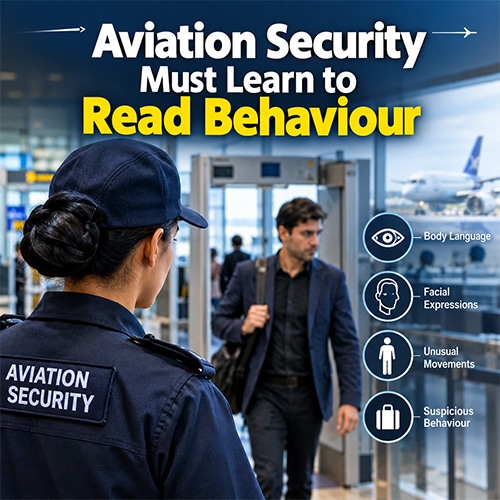
This is where aviation security could evolve from point-in-time clearance to continuous risk awareness. Behavioural observation could begin at terminal entry and continue through check-in, security, boarding and, where legally permitted, operational crew readiness procedures.
Emerging multimodal technologies could analyse observable indicators such as facial movements, gaze, posture, voice characteristics and physiological signals. FaceOff Technologies describes its approach as a Biological Behaviour Algorithm, combining multiple signals to generate behavioural and trust-risk indicators.
Such technology, however, should never claim to determine whether somebody is a terrorist, mentally unfit or dangerous merely from their face. Behavioural anomalies are risk signals, not proof of intent. ICAO defines behaviour detection around recognising unusual verbal, non-verbal, physiological or gestural characteristics and using trained personnel to assess them further.
A potential aviation security model could continuously observe and analyse behavioural signals, identify anomalies, generate a risk score, and refer significant deviations for human review and additional screening before a final security decision is made, rather than automatically denying boarding.
Pilots, cabin crew and other privileged personnel deserve particular attention because their authorised access creates different risks. But behavioural monitoring should complement—not replace—medical fitness programmes, peer-support systems, background checks and professional assessment. The FAA, for example, already requires medical examinations incorporating pilot mental-health considerations.
Privacy is equally critical. Any biometric or behavioural system would require clear purpose limitation, consent or other lawful basis where applicable, strong security, limited retention, auditability and safeguards against discrimination. IATA specifically says behavioural analysis should not be based on race, religion, colour or gender.
The future of aviation security may therefore move beyond simply asking, “Who are you and what are you carrying?”It may increasingly ask, “Has something materially changed in your behaviour that warrants human attention?”Used responsibly, technologies such as FaceOff's behavioural intelligence could become another layer in aviation's defence—helping security teams identify anomalies earlier while leaving consequential decisions with trained professionals.