
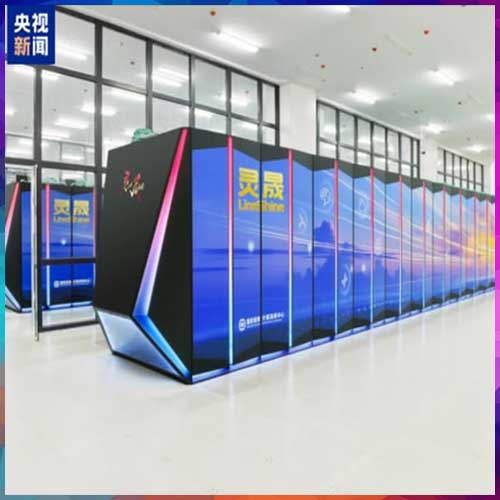
China’s LineShine supercomputer has topped the latest global supercomputing rankings, highlighting the country’s advances in domestic chip development, though experts say the achievement does not necessarily reflect leadership in AI-focused computing capabilities.
China has returned to the top of the global supercomputing rankings after its domestically developed LineShine system secured first place in the latest edition of the TOP500 list, a widely followed benchmark that measures the performance of the world's most powerful supercomputers.
The achievement marks China’s first appearance in the rankings in three years and comes amid intensifying technological competition between Beijing and Washington in advanced computing, semiconductors and emerging technologies.
Installed at the National Supercomputing Centre in Shenzhen, LineShine surpassed the United States’ El Capitan system, which had previously held the top position. The result underscores China’s continued investment in high-performance computing and its efforts to reduce reliance on foreign technology amid ongoing export restrictions.
However, industry observers caution that leading the TOP500 rankings does not automatically translate into dominance in artificial intelligence computing, where different performance metrics often apply.
Traditional supercomputing versus AI infrastructure
The TOP500 list is based on benchmark tests designed to evaluate how effectively a system performs large-scale scientific and mathematical calculations. Historically, these tests have been used to assess machines deployed by research institutions, universities and national laboratories for tasks such as climate modelling, materials science and complex simulations.
In recent years, however, the computing landscape has evolved significantly. Major cloud providers and AI companies have built vast computing clusters tailored specifically for training and running artificial intelligence models. Many of these systems are not submitted for inclusion in traditional supercomputing rankings.
As a result, experts argue that benchmark leadership in scientific computing should not be viewed as a definitive indicator of AI performance. While LineShine achieved the highest score in the TOP500 evaluation, it ranked lower in tests designed to reflect workloads more closely associated with AI applications.
Analysts note that some of the world’s largest AI-focused computing systems, operated by hyperscale technology firms, may possess substantially greater processing capabilities than many machines featured on conventional supercomputing lists.
Symbol of China’s technology self-reliance push
The latest ranking is being viewed by many industry watchers as a reflection of China's determination to showcase progress in indigenous chip and computing technologies.
For several years, China had largely withdrawn from submitting systems to international rankings as U.S. export controls tightened access to advanced semiconductor technologies. The decision to re-enter the rankings with a domestically powered system signals growing confidence in the country’s homegrown capabilities.
Experts say the LineShine project demonstrates China’s ability to design and deploy large-scale computing infrastructure using locally developed processors despite restrictions on access to some advanced chip technologies.
While debates continue over how best to measure computing leadership in the AI era, China’s return to the top of the supercomputing rankings is likely to be viewed as an important milestone in its broader strategy to strengthen technological independence and compete more effectively on the global stage.

See What’s Next in Tech With the Fast Forward Newsletter





Tweets From @varindiamag
Nothing to see here - yet
When they Tweet, their Tweets will show up here.