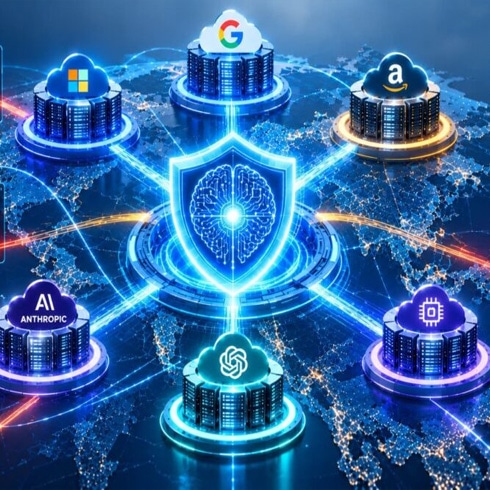
The global cybersecurity landscape is undergoing a fundamental transformation, with leading technology vendors moving towards integrated security platforms through acquisitions, strategic alliances and ecosystem consolidation. However, even as cybersecurity companies grow larger, a critical challenge remains: detecting increasingly sophisticated AI-generated attacks.
The reported $43.9 billion CrowdStrike–Zscaler acquisition signals a significant shift in the cybersecurity industry. Combining CrowdStrike’s endpoint protection and threat intelligence with Zscaler’s zero-trust networking capabilities could create a formidable cybersecurity powerhouse.
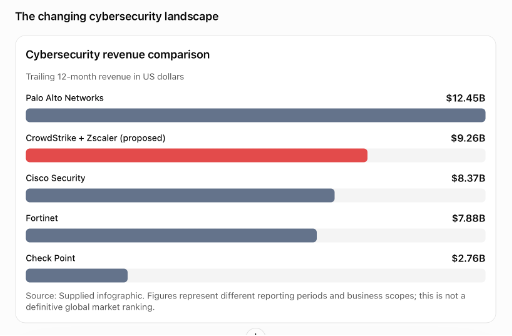
Based on the supplied revenue figures, the combined entity would generate $9.26 billion in annual trailing revenue, positioning it behind Palo Alto Networks and ahead of Cisco Security and Fortinet among the vendors compared.
According to the SEC filing dated November 23, 2026, the combined organization expects to start with more than $10 billion in annual recurring revenue (ARR), with opportunities to cross-sell CrowdStrike’s platform to approximately 8,000 Zscaler customers. The transaction remains subject to regulatory and shareholder approvals.
The industry is rapidly transitioning from standalone security products towards unified platforms encompassing endpoint protection, network security, cloud security, identity management, data protection and AI-powered security operations.
However, consolidation alone cannot guarantee protection against emerging AI-enabled deception. While leading cybersecurity vendors are investing heavily in AI-powered detection, attackers are simultaneously exploiting generative AI to manipulate human trust and undermine conventional authentication mechanisms.
Deepfake videos, cloned voices, synthetic identities, AI-generated documents, hyper-personalized phishing and autonomous cyberattacks are creating a new dimension of enterprise vulnerability.
The fundamental challenge arises when an attacker appears to be a legitimate employee, customer, executive or authorized AI agent. Even a secure network connection cannot independently establish whether the identity behind it is authentic.
Five critical gaps in the emerging AI security landscape
|
Emerging threat
|
Security capability required
|
|
Synthetic identity fraud
|
Multimodal identity verification
|
|
Deepfake impersonation
|
Real-time audio and video authenticity detection
|
|
AI-generated phishing
|
Contextual and behavioral intelligence
|
|
Stolen credentials and tokens
|
Continuous authentication and risk assessment
|
|
Compromised autonomous AI agents
|
Agent identity, authorization and runtime governance
|
From cybersecurity to cognitive security
The next evolution of cybersecurity must extend beyond protecting devices, networks and applications towards verifying the authenticity of humans, machines, digital content and autonomous agents.
This creates an opportunity for specialized digital trust platforms that complement existing cybersecurity infrastructure through deepfake detection, behavioral intelligence, advanced liveness verification and continuous identity authentication.
For CIOs, CISOs and channel partners, the priority should not simply be consolidating security vendors but identifying gaps that increasingly sophisticated AI-generated attacks can exploit.
The future of cybersecurity will not be determined solely by who owns the largest security platform, but by who can most effectively distinguish genuine digital interactions from artificial deception.