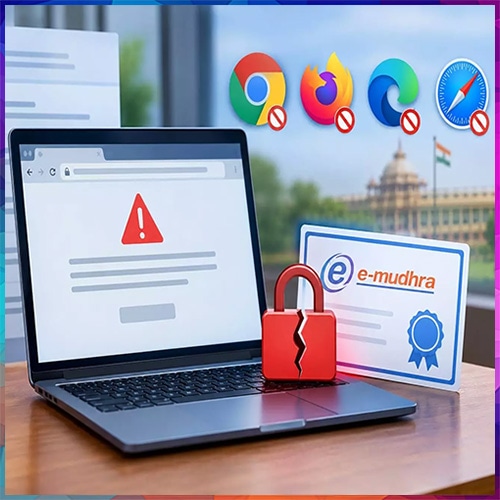
A major cryptographic security failure involving India's eMudhra has triggered an emergency response from Google, Mozilla and other global technology providers, raising serious concerns about the integrity of the internet's digital trust infrastructure.
Eight intermediate Certificate Authority (CA) private keys were reportedly compromised, exposing weaknesses in cryptographic key management. Reports indicate that some keys were extraordinarily small, despite the expectation that such credentials should possess exceptionally strong cryptographic protection.
The implications extend far beyond eMudhra's immediate customers. Compromised CA keys could potentially enable attackers to issue fraudulent digital certificates and impersonate legitimate websites, applications or APIs wherever affected certificate chains remain trusted.
Although major browser vendors have implemented emergency protections, the challenge is considerably greater for IoT devices, network appliances, embedded systems and enterprise applications that lack automatic certificate revocation mechanisms. Remediation across these environments could take significantly longer.
This is not merely a compromise of eight cryptographic keys; it is a warning about the fragility of the global internet's chain of trust. A failure involving one certificate authority can potentially expose organisations that have never directly engaged with that provider.
The incident also raises an important question for India's cybersecurity ecosystem: How could such fundamental cryptographic weaknesses escape established security controls and independent audits?
It is time for Indian regulators and relevant industry authorities to critically examine the effectiveness of mandatory security audits, certificate authority governance, cryptographic key-generation practices and continuous compliance monitoring.
The larger lesson is clear: digital trust cannot depend on periodic certification alone. It requires continuous verification, stronger cryptographic controls, transparent accountability and independent security validation.