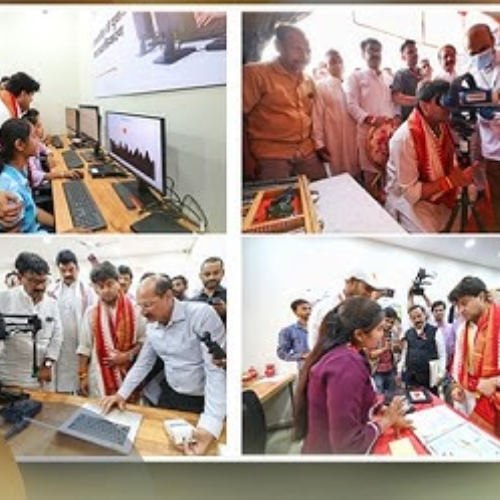


Union IT Minister Ashwini Vaishnaw unveiled Qualcomm’s advanced 2-nanometre chip in Bengaluru, highlighting India’s transition from a back-office destination to a hub for end-to-end semiconductor design, innovation and deep-tech manufacturing.
India has taken another step toward strengthening its semiconductor ambitions with the unveiling of a cutting-edge 2-nanometre chip developed by Qualcomm. Union Minister for Electronics and Information Technology Ashwini Vaishnaw showcased the advanced chip and wafer at an industry event in Bengaluru on February 7, underscoring the country’s growing capabilities across the semiconductor value chain.
Addressing the media, Vaishnaw said the development reflects India’s rapid progress in building an end-to-end semiconductor ecosystem, moving well beyond its earlier role as a support centre for global technology firms. “Our country is making major progress in semiconductor manufacturing design and is building the entire ecosystem in our country… I’m very happy to share with you that today we unveiled the two-nanometer wafer and two-nanometer chip at Qualcomm,” he said.
Shift to end-to-end chip development
The minister noted that Qualcomm’s achievement follows similar end-to-end design work already carried out by other global players. “AMD has done it, and now Qualcomm has done it. It’s a series of developments where companies are now designing end-to-end products in India,” Vaishnaw said.
Explaining the complexity of the technology, he highlighted that each silicon wafer contains dies with nearly 20 to 30 billion transistors. The chip integrates both CPU and GPU capabilities and can power a wide range of applications, from AI-enabled desktops and edge devices to connected cars, trains and aircraft.
Vaishnaw emphasised that the entire lifecycle—from customer product definition to silicon design, tapeout and validation—is now being executed within India, reflecting the country’s growing technical depth.
Building talent under the Semiconductor Mission
A key pillar of this progress, the minister said, is talent development under the India Semiconductor Mission. The government has set a target of training 85,000 semiconductor professionals over a decade. “I’m happy to share that, over four years, we have trained 67,000 semiconductor engineers,” he said, adding that 315 universities and colleges now have access to advanced chip design tools.
Recalling discussions with industry leaders at the World Economic Forum in Davos, Vaishnaw said India is expected to play a major role in bridging the global semiconductor talent gap.
Looking ahead, he confirmed that the upcoming Semicon Mission 2.0, announced in Budget 2026, will place strong emphasis on indigenous chip design. “In Semicon 2.0, the topmost priority will be designing companies… that can design a product, take it to the market, become the next Qualcomm from India,” he said.

See What’s Next in Tech With the Fast Forward Newsletter









Tweets From @varindiamag
Nothing to see here - yet
When they Tweet, their Tweets will show up here.