
Resilient Navigation in a GNSS-Denied World
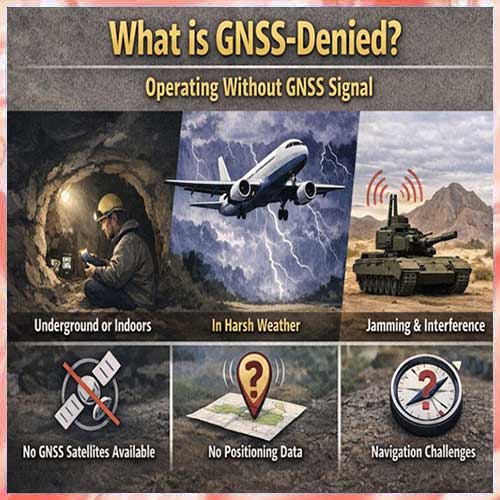
Global Navigation Satellite Systems (GNSS) have long been the invisible backbone of aviation and space operations. From precision landings to spacecraft docking, these signals enable accuracy, efficiency, and safety. However, their greatest strength—ubiquity—has also become a vulnerability. GNSS signals reach Earth at extremely weak power levels, making them highly susceptible to disruption. As interference incidents rise globally, the focus is shifting toward resilient navigation frameworks built on Alternative Positioning, Navigation, and Timing (A-PNT).
GNSS vulnerabilities stem from both natural and human-induced threats. The ionosphere can distort signals, especially during solar maximums, causing loss of lock. Solar radio bursts and geomagnetic storms further degrade accuracy, impacting aviation systems like SBAS. On the human side, jamming can block signals entirely, while spoofing can mislead receivers with false data—posing serious risks by providing incorrect positioning without triggering alarms.
In space operations, the challenge intensifies. High-altitude satellites rely on weak signal spillovers, while atmospheric re-entry causes complete signal blackout due to plasma formation. Precision tasks like docking or formation flying demand accuracy that GNSS alone cannot reliably provide under such conditions.
To address these risks, the aerospace sector is embracing multi-layered navigation approaches. Inertial Navigation Systems (INS), using accelerometers and gyroscopes, offer autonomous and interference-resistant navigation, though they suffer from drift over time. Ground-based systems like DME and eLoran provide strong, jam-resistant signals, while Signals of Opportunity (SoOP) leverage existing communication networks such as cellular or LEO satellites.
Vision-based navigation is also gaining traction. Terrain-Referenced Navigation (TRN) compares real-time sensor data with digital maps, while star trackers and crater-matching techniques enable precise navigation in deep space environments.
Emerging technologies like quantum inertial sensors promise near-zero drift, potentially redefining navigation accuracy. Equally critical is resilient timing—enabled by chip-scale atomic clocks and fiber-based synchronization—to maintain system integrity during GNSS outages.
The future of navigation lies not in replacing GNSS, but in augmenting it. A resilient, multi-source PNT ecosystem will be essential to ensure safety, reliability, and operational continuity in an increasingly contested and complex environment.

See What’s Next in Tech With the Fast Forward Newsletter








Tweets From @varindiamag
Nothing to see here - yet
When they Tweet, their Tweets will show up here.