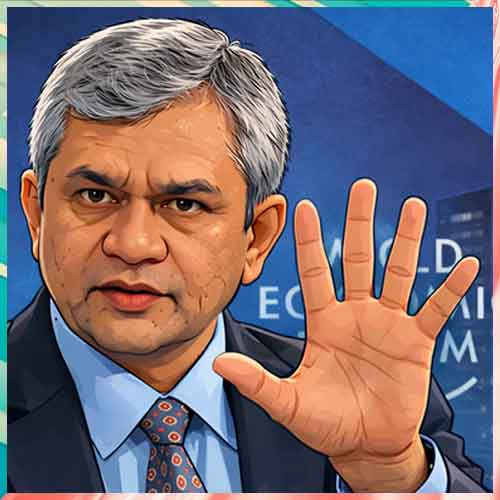
India’s Union Minister for Electronics and Information Technology Ashwini Vaishnaw has firmly rejected suggestions that India trails behind the world’s leading artificial intelligence nations, countering remarks made during a high-level discussion at the World Economic Forum in Davos.
Speaking on a panel that also included International Monetary Fund Managing Director Kristalina Georgieva, Vaishnaw said India should be considered among the top-tier AI countries alongside the United States and China.
Georgieva had indicated that India falls into a second group of nations in the global AI landscape, behind frontrunners such as the US and China. Vaishnaw strongly disputed this assessment, questioning the criteria used by the IMF and arguing that it does not reflect widely accepted global benchmarks.
“I don’t know what criteria the IMF is using, but Stanford places India third globally in AI preparedness,” Vaishnaw said during the discussion. “India clearly belongs in the first group of AI nations.”
Citing global benchmarks
To support his argument, the minister referred to assessments by Stanford University, which track countries on parameters such as AI readiness, talent availability, and adoption. According to Vaishnaw, these rankings place India third worldwide in AI preparedness and penetration, and second in AI talent.
He reiterated that branding India as a “second-tier” AI player does not align with the data or the country’s current capabilities.
India’s end-to-end AI strategy
Vaishnaw also outlined India’s broader approach to artificial intelligence, stressing that the country is investing across the entire AI value chain rather than focusing on isolated segments. He said India’s AI roadmap spans five key layers — applications, foundational models, semiconductor chips, infrastructure, and energy.
“We are working across all five layers and making strong progress in each,” the minister said, highlighting the government’s push to build a resilient and self-sustaining AI ecosystem.
His remarks come ahead of India hosting the AI Impact Summit next month, where the country is expected to highlight advances in AI adoption, talent development, and responsible innovation.
Massive investments underway
In separate interactions at Davos, Vaishnaw said India has already attracted substantial investments in AI-enabling infrastructure, including data centres, high-performance computing, semiconductors, and power generation. He noted that cumulative investments in these areas are on track to exceed $150 billion by the end of 2026.
Looking ahead to the upcoming summit, the minister said India could see a fresh wave of investments worth up to $100 billion. “Around $70 billion is already in progress, and we expect another $50–80 billion during the summit. I wouldn’t be surprised if the total crosses $100 billion,” he said.
These investments, Vaishnaw added, will span artificial intelligence, semiconductor manufacturing, digital infrastructure, and energy — reinforcing India’s ambition to position itself as a global AI powerhouse.
Speaking on a panel that also included International Monetary Fund Managing Director Kristalina Georgieva, Vaishnaw said India should be considered among the top-tier AI countries alongside the United States and China.
Georgieva had indicated that India falls into a second group of nations in the global AI landscape, behind frontrunners such as the US and China. Vaishnaw strongly disputed this assessment, questioning the criteria used by the IMF and arguing that it does not reflect widely accepted global benchmarks.
“I don’t know what criteria the IMF is using, but Stanford places India third globally in AI preparedness,” Vaishnaw said during the discussion. “India clearly belongs in the first group of AI nations.”
Citing global benchmarks
To support his argument, the minister referred to assessments by Stanford University, which track countries on parameters such as AI readiness, talent availability, and adoption. According to Vaishnaw, these rankings place India third worldwide in AI preparedness and penetration, and second in AI talent.
He reiterated that branding India as a “second-tier” AI player does not align with the data or the country’s current capabilities.
India’s end-to-end AI strategy
Vaishnaw also outlined India’s broader approach to artificial intelligence, stressing that the country is investing across the entire AI value chain rather than focusing on isolated segments. He said India’s AI roadmap spans five key layers — applications, foundational models, semiconductor chips, infrastructure, and energy.
“We are working across all five layers and making strong progress in each,” the minister said, highlighting the government’s push to build a resilient and self-sustaining AI ecosystem.
His remarks come ahead of India hosting the AI Impact Summit next month, where the country is expected to highlight advances in AI adoption, talent development, and responsible innovation.
Massive investments underway
In separate interactions at Davos, Vaishnaw said India has already attracted substantial investments in AI-enabling infrastructure, including data centres, high-performance computing, semiconductors, and power generation. He noted that cumulative investments in these areas are on track to exceed $150 billion by the end of 2026.
Looking ahead to the upcoming summit, the minister said India could see a fresh wave of investments worth up to $100 billion. “Around $70 billion is already in progress, and we expect another $50–80 billion during the summit. I wouldn’t be surprised if the total crosses $100 billion,” he said.
These investments, Vaishnaw added, will span artificial intelligence, semiconductor manufacturing, digital infrastructure, and energy — reinforcing India’s ambition to position itself as a global AI powerhouse.