

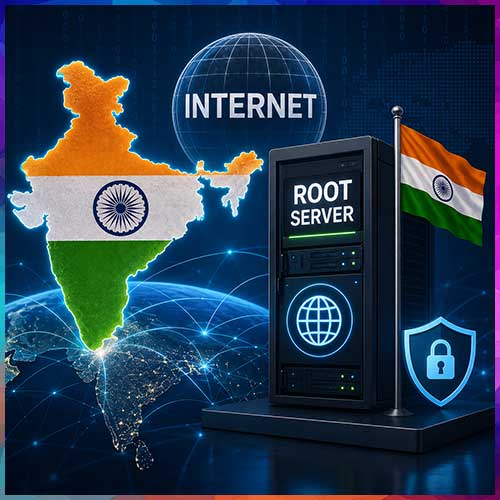
The government has approached ICANN to establish an internet root server in India, a move aimed at improving network resilience, enhancing cybersecurity preparedness, reducing latency, and supporting the country’s broader digital sovereignty ambitions.
India has initiated discussions with the Internet Corporation for Assigned Names and Numbers (ICANN) to establish an internet root server within the country, a move that could bolster the resilience and efficiency of its rapidly expanding digital ecosystem.
The proposal comes as India continues to witness unprecedented growth in internet adoption, driven by affordable mobile data and widespread smartphone usage. With over a billion internet users, policymakers believe the country should play a larger role in hosting critical components of the global internet infrastructure.
The issue was highlighted by Ministry of Electronics and Information Technology (MeitY) Secretary S Krishnan during the National Internet Exchange of India’s (NIXI) 23rd Foundation Day event. He noted that India’s vast internet population and growing dependence on digital services justify the need for local root server infrastructure.
Root servers form the backbone of the global Domain Name System (DNS), the mechanism that allows internet users to access websites and online services through familiar web addresses. These servers help direct internet traffic by translating domain names into numerical IP addresses, enabling devices to locate and communicate with online destinations.
Why root servers matter
Often described as the internet’s foundational directory, root servers play a critical role in ensuring that web requests are routed accurately and efficiently. While internet users rarely notice their operation, these systems are essential to nearly every online activity, from browsing websites and sending emails to accessing cloud applications.
At present, DNS queries generated in India are handled through root server infrastructure located in other parts of the world. Although ICANN operates root server clusters across several regions, including North America, Europe, Africa, and Asia, India does not currently host one of these critical facilities.
Government officials argue that distributing such infrastructure more broadly across geographies can improve the overall resilience of the global internet while reducing dependence on a limited number of locations.
Potential benefits for performance and security
Industry experts believe a locally hosted root server could improve internet performance by reducing the distance DNS requests must travel. Faster query processing could contribute to lower latency, better network efficiency, and more responsive online services for users and businesses.
The proposal also carries cybersecurity implications. Policymakers have increasingly emphasised the importance of strengthening digital infrastructure to counter evolving cyber threats. Localised root server infrastructure could support quicker response mechanisms during cyber incidents and help internet service providers manage malicious traffic more effectively.
The initiative aligns with India's broader push toward digital self-reliance and infrastructure sovereignty. As discussions with ICANN continue, the proposed root server is being viewed as a strategic step toward reinforcing the country's digital foundations and supporting the next phase of its internet-driven growth.

See What’s Next in Tech With the Fast Forward Newsletter






Tweets From @varindiamag
Nothing to see here - yet
When they Tweet, their Tweets will show up here.