Across nearly every regulated-industry AI story this year — India's DPDP Act, government deepfake detection, banking Secret Manager deployments, It is an appliance — the same technical bottleneck keeps recurring: serious AI capability has historically required a data center, but serious data privacy compliance often requires the opposite — keeping everything on-premise. NVIDIA's DGX Spark is a direct answer to that tension, and it's worth examining why it matters specifically for data privacy and compliance-focused AI applications.
Amazing DGX Spark Brings:
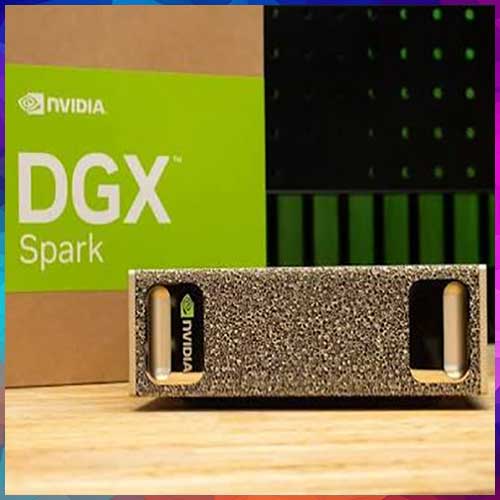
Powered by the NVIDIA GB10 Grace Blackwell Superchip — a system-on-chip pairing a 20-core Arm CPU with a Blackwell-generation GPU — DGX Spark delivers up to 1 petaFLOP of AI performance at FP4 precision in a compact, desktop-sized unit (roughly 150mm x 150mm x 50mm). Its standout specification is 128GB of unified system memory shared coherently between CPU and GPU, letting developers run and fine-tune reasoning models with up to 200 billion parameters entirely locally, with the ability to cluster two units together to handle models up to 405 billion parameters. The system ships with the full NVIDIA AI software stack preinstalled, so AI projects can be operational quickly rather than requiring weeks of environment setup.
Critically, it runs at roughly 140W — comparable to an ordinary high-end workstation, not a server rack — plugging into a standard power outlet with no specialized cooling or electrical infrastructure required.
This Matters for Data Privacy Applications Specifically:
It solves the "give us your data to protect your data" contradiction. When we talk about ,DPDP-style compliance — data discovery, classification, redaction, consent management, breach monitoring — traditionally required sending sensitive records to a cloud platform, creating exactly the transfer risk the regulation is meant to prevent. DGX Spark's unified memory and desktop-class compute mean the vision and language models needed to scan documents, images, video, and unstructured contracts for personal data can run entirely inside an organization's own building, with nothing uploaded and nothing processed on shared infrastructure.
AI sovereignty, not just data sovereignty. A recurring theme across this year's compliance discussions is that data residency alone isn't sufficient — if the AI model itself sits with a third-party provider, prompts and outputs still leave the building conceptually, even if the raw files don't. DGX Spark closes that gap: model weights, inference, and intermediate outputs all stay on customer-owned hardware, which matters enormously for hospitals, defense-linked suppliers, banks, and government departments where "the model provider could theoretically see this" is itself disqualifying.
It removes the infrastructure-project excuse. The traditional on-premise alternative to cloud AI compliance tools has been building out AI-capable server infrastructure — a process involving procurement cycles, rack space, three-phase power, and industrial cooling, often taking months. DGX Spark compresses that into a single desktop unit that plugs into a normal socket, meaning a mid-sized enterprise facing a statutory compliance deadline doesn't need to become an infrastructure company first.
Purpose-built for the exact workload privacy platforms need. NVIDIA specifically positions DGX Spark for building and running autonomous agents locally and securely — directly applicable to the kind of continuous-monitoring, always-on data discovery and classification agents that modern DPDP/GDPR compliance platforms increasingly rely on, rather than one-off batch scans.
The Broader Pattern
DGX Spark represents the hardware side of a shift we've traced repeatedly this year: as AI models get woven into compliance, identity verification, and fraud detection — domains where "where does the data go" is a legal question, not just a technical one — the winning architecture increasingly separates two things that used to be bundled: frontier-scale AI capability, which used to demand a data center, and frontier-scale AI compliance, which demands the opposite. Desktop-class superchips like DGX Spark are what make it possible to have both simultaneously — meaningful local AI power without surrendering data sovereignty to get it.