

Breaking News
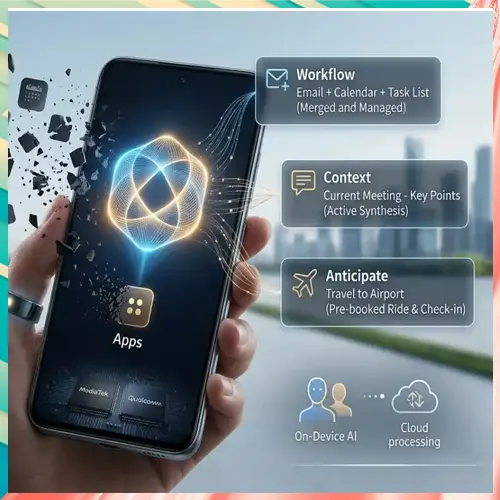
OpenAI is reportedly working on a smartphone that could rival Apple’s iPhone, in a bold attempt to reshape how users interact with AI and potentially solve the company’s growing monetisation challenges.
According to a note by TF International Securities analyst Ming-Chi Kuo, the device is targeted for a 2028 launch and is being developed in partnership with semiconductor firms Qualcomm and MediaTek. Manufacturing discussions are also said to be underway with Luxshare Precision, a China-based assembler that already supplies components for Apple products.
The proposed smartphone is expected to run on a proprietary OpenAI operating system and shift away from traditional app-based usage. Instead, it would rely heavily on AI agents capable of performing tasks autonomously on behalf of users.
AI Agents at the Core of a New Device Strategy
Unlike current smartphones that depend on users manually opening apps, OpenAI’s device is expected to interpret user intent and execute actions directly through embedded AI agents. These agents would continuously learn user behaviour and preferences, aiming to complete tasks with minimal input.
The design direction is reportedly influenced by former Apple designer Jony Ive, who is collaborating with OpenAI on hardware concepts.
Kuo noted that the device would combine on-device and cloud-based AI, with simpler tasks handled locally and more complex computing processed remotely. The goal is to create a system that understands real-time context and acts as a continuous digital assistant.
OpenAI CEO Sam Altman has also hinted at upcoming hardware innovation, saying earlier this year that the company may reveal more details soon. He described AI-native devices as a shift away from traditional computing interfaces that have remained largely unchanged for decades.
Monetisation Pressure Driving Hardware Expansion
Analysts suggest the move into smartphones reflects a broader attempt by OpenAI to strengthen revenue streams amid ongoing questions about AI monetisation. While competitors like Anthropic have seen traction in enterprise markets, OpenAI has faced challenges in scaling consumer revenue.
Industry observers also point out that building a smartphone ecosystem could allow OpenAI to control both hardware and software layers, enabling deeper integration of AI services and potential subscription-based models.
However, the strategy also faces significant hurdles, including intense competition in the smartphone market, regulatory scrutiny, and the complexity of building a new ecosystem from scratch.
Despite these challenges, the development signals a potential shift in the AI industry—from software-first models to vertically integrated hardware platforms designed around autonomous AI agents.

See What’s Next in Tech With the Fast Forward Newsletter




Tweets From @varindiamag
Nothing to see here - yet
When they Tweet, their Tweets will show up here.