French startup Qarnot has raised a €12.5 million funding round ($13.3 million at today’s exchange rate). It has also negotiated a €22.5 million credit line ($24 million) to finance its future projects.
Qarnot started with electric heaters for construction companies looking for heaters for their new buildings. The company put servers in those heaters so that CPUs and other components would generate heat. The rest of the heater would act as a passive cooling system and warm residential and office buildings.
At the other end, companies such as BNP Paribas, Société Générale and 3D animation studio Illumination are renting those servers for their own needs. This is an innovative way of building decentralized data centers.
Paul Benoit Co-Founder and CEO, Qarnot said, “Ever since we launched Qarnot 12 years ago, our goal has been to valorize fatal heat from computers. Today, it’s a hot topic and there are a lot of people talking about it.”
The main issue with this system is that you don’t need a heater all year round. Qarnot has found a way to counter this seasonality effect by building a new product — scalable boiler systems.
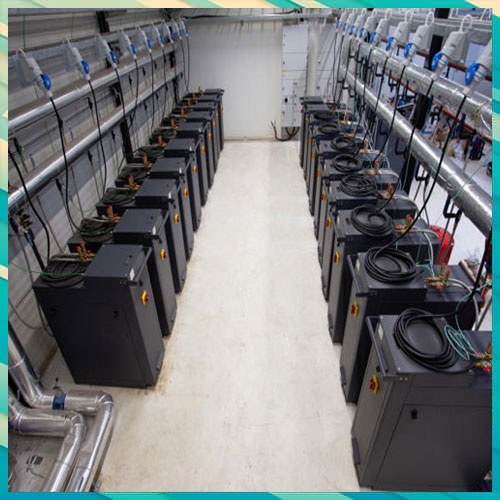
These modules pack up to 12 servers with a standard form factor based on Open Compute Project server designs with AMD Epyc and Intel Xeon CPUs. Each module is then connected to the water system so that cold water enters the module and is turned into hot water. Up to 95% of computer waste heat is turned into hot water.
Qarnot can provide multiple modules and make them work in parallel. It generates more hot water and it increases the total compute power of the Qarnot platform.
“The idea is that we should be able to deploy data centers in locations where people consume heat. It’s a completely different approach compared to traditional data centers,” Benoit said.