
Digital sovereignty has moved from a regulatory footnote to a boardroom priority, though some enterprise buyers are still not yet ready to pay a premium for it. In a poll of enterprise and telecom operator decision makers*, 76% said digital sovereignty is a consideration in their organization with 56% stating it is very important. Yet only 51% would pay a premium for a sovereign solution, reveals GlobalData.
The report reveals that, support thins at each step toward commitment. Although 76% of respondents state their ambitions regarding sovereignty, only 59% say AI deployment plans are actively informing their sovereignty roadmap. And of the 51% willing to pay a premium, only half would pay more than 20% extra to secure some degree of digital independence.
“Buyers talk sovereignty, but only half will put money behind it. The biggest contrast comes between wanting sovereignty and planning for it, rather than between planning and paying. Tying sovereignty to concrete AI deployments is the most effective way to turn interest into spend.”
Regional differences reveal a fragmented picture. Of the analyzed regions, every respondent from India values sovereignty, and 75% would pay a premium, the strongest commitment in the poll. In East and Southeast Asia, 82% value sovereignty and 67% would pay more. The EU shows the widest gap: 80% value sovereignty, but only 42% would pay more. In the US, 75% value sovereignty and 46% would pay a premium, with just 4% accepting one above 20%. The UK respondents value sovereignty least, at 60%, but 50% would pay more.
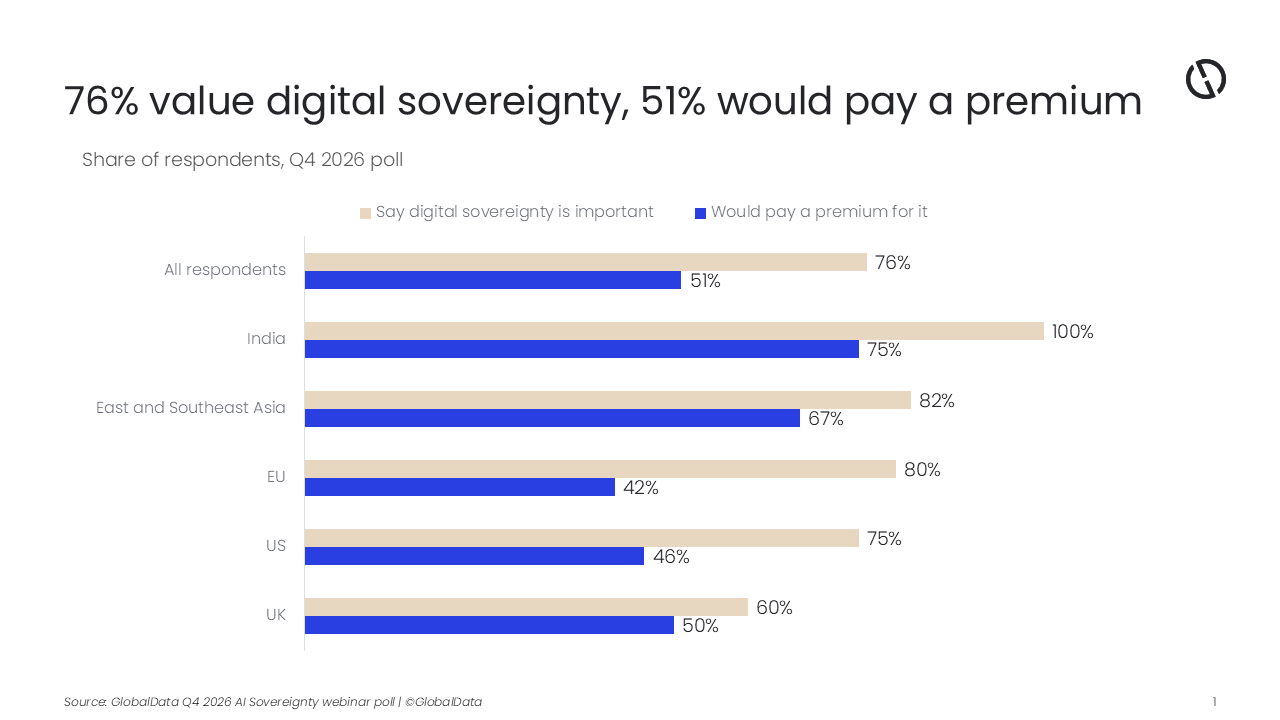
Patel continues: “Whether buyers pay for sovereignty depends on the role their government plays. In India, the government sets the direction, and buyers budget for it. EU buyers are increasingly expecting regulation to make sovereignty the default, so most see no reason to pay extra. The US buyers already sit inside the dominant technology stack and will thus pay only modest premiums.”
Patel concludes: “Full sovereignty is utopian and out of reach for almost everyone. Vendors and telcos should sell trust and control instead of mere independence, and prove it across data, compute, and connectivity. Honesty about limitations is a stronger trust signal than sovereignty-washing.”
GlobalData conducted the poll on sovereignty. It asked enterprise and telco decision makers three questions: how important digital sovereignty is to their organization, how much AI deployment plans are driving their digital sovereignty strategy, and how much extra they would pay for a digital sovereign solution. The poll defined digital sovereignty as control over, and compliance for, data storage; control and management of critical infrastructure through trusted personnel and entities; and the ability to run applications without overreliance on foreign suppliers. Poll dates, number of respondents, and regional sample sizes are accessible to subscribers to GlobalData Technology’s Intelligence Center.