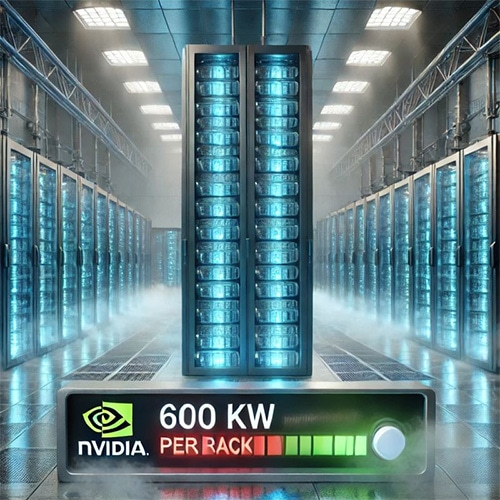
The artificial intelligence revolution is approaching a critical infrastructure bottleneck—not computing power, but electricity. NVIDIA's upcoming Kyber architecture, designed for its Rubin Ultra NVL576 platform, could require approximately 600 kilowatts per rack, exposing unprecedented challenges for global data centre operators.
According to Wccftech, a single Kyber installation could consume electricity comparable to roughly 500 American households. This extraordinary concentration of computing power highlights the widening gap between AI hardware innovation and infrastructure readiness.
Key Highlights
-
600kW Power Demand: NVIDIA's proposed Kyber racks could consume electricity equivalent to approximately 500 households.
-
Infrastructure Bottleneck: Existing data centres face major power distribution and cooling limitations.
-
Rising Capital Investment: Hyperscalers must modernise electrical systems and deploy advanced cooling technologies.
-
Deployment Uncertainty: Manufacturing challenges and infrastructure readiness could influence Kyber's commercial rollout.
-
Energy Defines AI Leadership: Reliable power, sustainable infrastructure and efficient data centres will determine future competitiveness.
The escalation is dramatic. While conventional enterprise racks may consume around 8kW, NVIDIA's Blackwell-generation systems can demand approximately 120kW. The proposed Kyber configuration represents a fivefold increase, requiring substantial redesigns of electrical distribution and cooling infrastructure.
Existing data centres are largely unprepared for such extreme power densities. Conventional power delivery systems, cooling technologies and electrical layouts cannot easily accommodate these requirements without significant investment in infrastructure modernisation.
Hyperscalers consequently face mounting financial and operational pressures. Procuring advanced GPUs is no longer sufficient; organisations must secure reliable electricity, high-capacity power distribution, advanced liquid cooling and appropriate facilities before deploying next-generation AI clusters.
Manufacturing complexities add another uncertainty. Industry reports have suggested potential delays affecting Kyber's deployment, although NVIDIA maintains that its technology roadmap remains intact. Therefore, the projected 600kW requirement should be viewed as a future infrastructure target rather than widespread operational reality.
The larger message is unmistakable: the next AI race will be determined as much by energy infrastructure as semiconductor innovation. Countries and enterprises capable of delivering sustainable electricity, resilient grids and efficient cooling will gain a decisive advantage in the global AI economy.