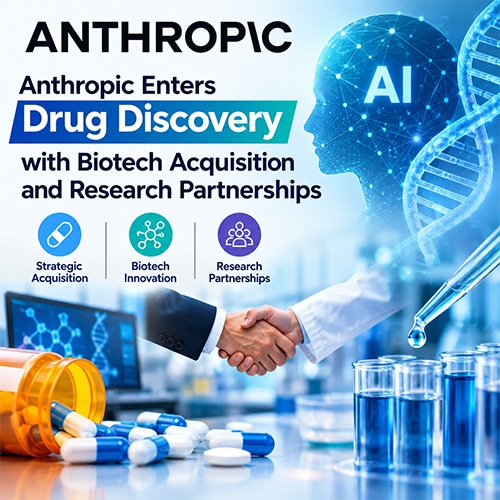
Anthropic has bought one-person biotech Mithril Medicine and signed research partnerships with six organisations, including Bristol Myers Squibb, as it pushes Claude into drug development, though all reported results remain preclinical and unproven in humans.
Anthropic, the maker of the Claude AI chatbot, is extending its reach beyond writing and coding help into healthcare. On October 27, the company announced that it will help develop new medicines, backing the move with the acquisition of Mithril Medicine and joint research partnerships with six organisations, among them BigHat Biosciences and Bristol Myers Squibb.
Mithril is a biotech startup with a single employee, founder Cody Tranbarger. Using Claude as his assistant, he managed contracts, logistics and experiments spread across 11 outside laboratories. The firm is working on treatments for two rare forms of muscular dystrophy. According to the announcement, it took a drug candidate from concept to successful testing in mice in under 18 months. If those early results hold, human clinical trials could begin as early as late 2028.
Time savings reported by partners
The announcement also highlighted efficiency gains at partner companies. Biotech firm Enveda used Claude to review a 1,061-page manufacturing document. The AI identified all 11 errors that human reviewers had found and flagged seven more they had missed. Verification effort fell by 89 per cent, from more than 25 hours to under three. In another case, Claude drafted a complex regulatory document in four hours, work that would manually take about three months.
Bristol Myers Squibb used the technology to assess its early-stage clinical trial plans. The company said that estimating a trial’s probability of success normally takes several days, whereas Claude produced an initial analysis from a single prompt.
Help with designing treatments
Claude is also being applied to the design of drugs themselves. BigHat Biosciences used it to optimise antibody fragments, producing designs that bind to their targets more than 10 times better and show marked gains in stability. Divergence Labs generated around 35,000 antibody designs for food allergy treatments in a single month. Generate Biomedicines relied on the tool for cell therapy design, and the gene designs it proposed were 70 per cent shorter than those from standard models.
To support the push, Anthropic has launched Claude Science, a dedicated workbench for researchers, along with a Life Sciences Verification Programme.
The company cautioned that every one of these results is at the preclinical stage. The figures come from the partner companies’ own laboratory work and have not been shown to be safe or effective in people.
Anthropic is not alone in the race. On October 20, 2026, rival OpenAI said it had acquired Orchestra Bio, a sign that large technology firms increasingly see drug discovery as the next major frontier for AI.