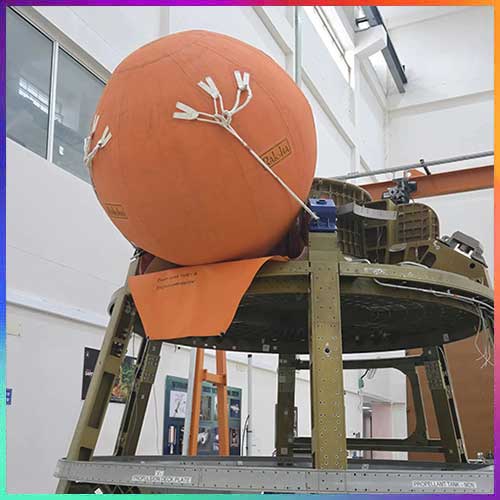
The Indian Space Research Organisation (ISRO) has successfully carried out three major tests of the Gaganyaan crew module systems. The first test ensured the crew module maintains an upright position after splashdown in the sea, which is considered one of the most important crew safety requirements. To achieve this, ISRO developed and tested a stored cold-gas-based uprighting system.
In a statement ISRO said that a system-level qualification test setup consisting of all the elements of CMUS (crew module uprighting system) was realized and successfully conducted inflation tests for the primary inflation module.
The second test examined the separation of the umbilical mechanism, which links the crew module (where astronauts live) and the service module (which provides power and propulsion).
The mechanism consists of two parts: CSU-1, located on the crew module side, and CSU-2, located on the service module side.
During the crew module's Earth re-entry stage, the service module first separates from the crew module after CSU-1 disconnects. Subsequently, CSU-2 also separates just before re-entry.
"Separation test of CSU-2 from simulated crew module was carried out. The test demonstrated the clean separation of CSU-2 as well as structural stability of the crew module panel and their interfaces," ISRO said.
The third test then validated the structural integrity of the crew module during the apex cover separation event.

See What’s Next in Tech With the Fast Forward Newsletter







Tweets From @varindiamag
Nothing to see here - yet
When they Tweet, their Tweets will show up here.