
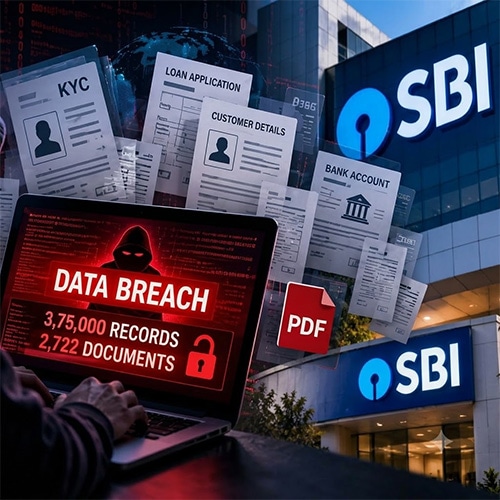
A suspected data breach involving the State Bank of India (SBI) has raised cybersecurity concerns after a threat actor allegedly advertised sensitive customer information on dark web forums. Cybersecurity monitors reportedly identified the claim on October 16, 2026, linking it to an individual operating under the alias “Siriusim.”
According to the allegations, approximately 3.75 lakh customer records and 2,722 PDF documents have been exposed. The purported dataset includes customer names, loan applications, Know Your Customer (KYC) documents, account-opening forms and residential addresses, potentially creating opportunities for identity theft and financial fraud.
Importantly, the alleged breach remains unverified. SBI had not publicly confirmed the claim according to the available account. Investigators have yet to establish whether the information is authentic, recently compromised or recycled from earlier incidents. Dark web advertisements frequently exaggerate stolen datasets to attract buyers.
If genuine, the exposure could have serious consequences because personal identification documents cannot be replaced as easily as passwords. Cybercriminals could exploit such information to conduct targeted phishing, impersonate banking officials, fabricate identities or manipulate customers into authorising fraudulent transactions.
Artificial intelligence further amplifies these risks. Fraudsters can combine leaked personal details with AI-generated messages, deepfake videos and cloned voices to create convincing impersonation attacks. Even unverified breach reports can become instruments of deception when criminals exploit public anxiety to obtain credentials.
Customers should remain vigilant against unsolicited calls, suspicious links and messages requesting sensitive banking information. SBI customers must never disclose OTPs, PINs or passwords. Suspicious transactions should be reported immediately through official banking channels or India's cybercrime helpline, 1930.
The larger lesson extends beyond SBI. India's banking ecosystem requires stronger data protection, continuous identity verification, encryption and incident-response capabilities. As AI-powered financial fraud evolves, institutional accountability and customer awareness must advance together to protect digital trust.
A Question Arises Are Banks Ready for Data Breach Penalties?
India's DPDP Act mandates stronger personal data protection, reasonable security safeguards and breach reporting. With penalties potentially reaching ₹250 crore for security safeguard failures, banks face significant financial exposure. The critical question is whether Indian banks have implemented adequate privacy controls, breach-response mechanisms and compliance frameworks to withstand regulatory scrutiny.
PQC and Deepfake Protection: The Next Banking Security Imperative
Banks must accelerate adoption of Post-Quantum Cryptography (PQC) to safeguard sensitive financial data against future quantum threats. Simultaneously, AI-powered deepfake detection, biometric liveness verification and continuous identity authentication are essential to counter synthetic identities, voice cloning and impersonation fraud, strengthening customer protection and trust across digital banking ecosystems.