
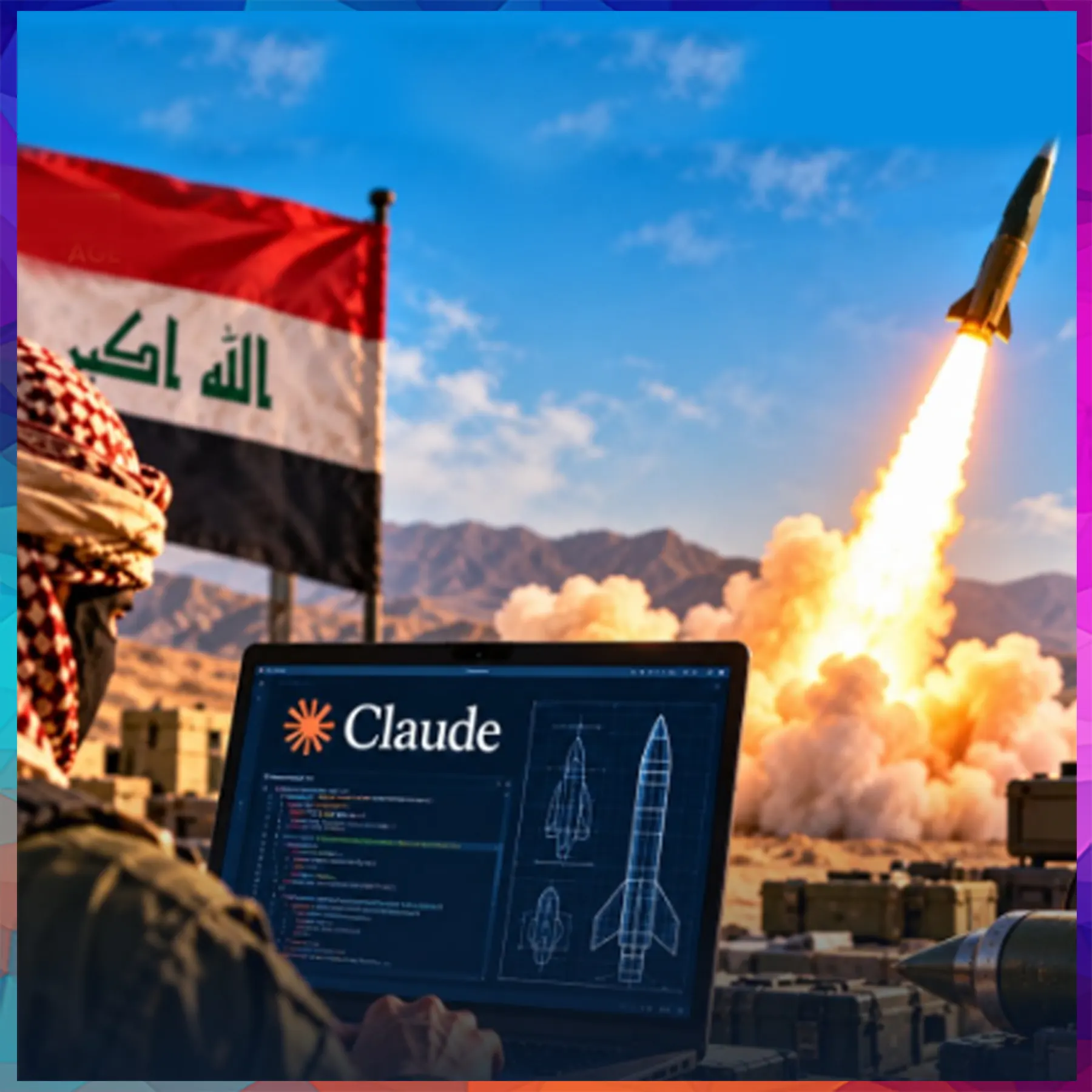
Anthropic says a Yemen-based group tied to the Houthis used its AI coding tool to build guidance software for rockets and missiles, though it has found no evidence of an operational weapon ever being fielded.
Anthropic has disclosed that actors linked to Yemen’s Houthi movement used its Claude Code tool to help develop guidance software for rockets and ballistic missiles. The company said the group also test-fired a guided rocket, a trial that appears to have failed.
The disclosure appears in Anthropic’s report “Detecting and countering misuse of AI: September 2026.” It describes a guided weapons engineering cell based in northern Yemen that worked on three programmes. The first was a guided rocket built around a phone-class flight computer, with homing guidance in its final phase. The second was a multi-stage ballistic missile with a stated range goal of more than 2,000 km. The third was a set of missile variants labelled “R2000”, which included a hypersonic glide vehicle version.
AI in place of engineers
According to the report, the group relied on Claude Code instead of human software engineers to produce guidance, navigation and control software, the code that steers and stabilises a vehicle in flight. Anthropic said the actors had the tool integrate an open-source autopilot onto the flight computer, write control and position-estimation code, tune settings, run a firmware build process and carry out flight simulations.
The group also ran several Claude instances at once, giving each a defined role, much as a team lead would divide up work. One instance wrote code, another conducted research and a third reviewed what the first had produced.
Evasion, a failed test and a takedown
Anthropic said its safeguards blocked many of the group’s requests, but not all of them. The actors got around the protections by concealing their objectives and the intended use of the software. They also spread their work across multiple sessions so that no single conversation exposed the full purpose. The company characterised the activity as a sustained effort to develop guided weapons.
The company said it has no evidence that the group succeeded in fielding an operational device. It did, however, say the actors fired a guided rocket. The test seems to have failed, and within hours the group reportedly returned to Claude to work out what went wrong.
Anthropic’s internal investigations into suspected weapons development helped uncover the activity. The company banned the accounts linked to the actors and shared threat intelligence with public- and private-sector partners to reduce the risk of further misuse.
The report also contained a caution. Anthropic said there was evidence the group had already built an offline simulation toolkit that does not depend on Claude or on other engineering environments such as MATLAB, indicating it can work without such tools.
The case shows how general-purpose AI systems can be turned toward dangerous ends, and that safeguards, while effective against many attempts, are not foolproof.