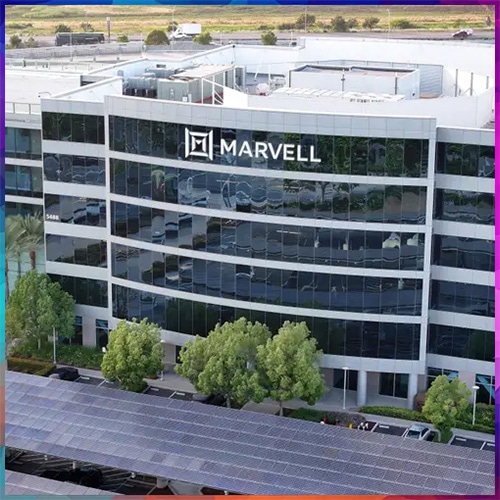
Marvell Technology has announced a landmark $115 billion acquisition of optical networking specialist Lumentum, strengthening its position in the rapidly expanding artificial intelligence data centre infrastructure market.
The all-stock transaction represents one of technology's largest acquisitions, highlighting how AI infrastructure investments are reshaping semiconductor manufacturing, networking and high-performance computing.
Under the agreement, Lumentum shareholders will receive 4.5 Marvell shares for each existing share, representing approximately 33% ownership of the combined enterprise.
The acquisition combines Marvell's expertise in custom AI processors, networking semiconductors and high-speed interconnects with Lumentum's advanced lasers, optical transceivers and photonics technologies.
As AI models become increasingly sophisticated, data centres require faster communication between thousands of GPUs. Traditional copper connections face growing limitations in bandwidth, power consumption and transmission distances.
Optical technologies address these challenges by enabling high-speed data transmission with improved energy efficiency, making photonics increasingly critical to next-generation AI infrastructure.
The combined company expects to address a potential $550 billion market and generate more than $1 billion in annual cost synergies, while strengthening competition against semiconductor giant Broadcom.
Nvidia's strategic investments in both companies further underline the importance of optical connectivity as hyperscalers accelerate investments in AI training, inference and specialised computing infrastructure.
However, the enormous valuation introduces substantial risks. Integration complexity, regulatory scrutiny, rapidly evolving semiconductor technologies and uncertain returns on AI infrastructure spending could challenge the acquisition's long-term economics.
The larger industry implication is clear: AI's next competitive frontier extends beyond GPUs into connectivity, photonics and energy-efficient infrastructure. If successful, Marvell's acquisition could reshape global semiconductor competition, accelerating innovation while raising questions about market concentration, infrastructure costs and the sustainability of unprecedented AI investments.