
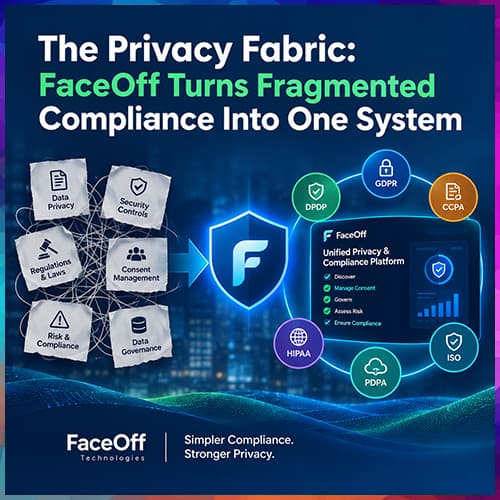
Enterprise privacy often fails not because organizations lack privacy tools, but because those tools operate in silos. Consent may sit in one system, personal data spans dozens of applications, rights requests flow through a separate workflow, and audit evidence lives somewhere else entirely. FaceOff Privacy addresses this structural gap through a shared Privacy Fabric, connecting eight privacy products to one common operating layer.
At its foundation sits a shared data catalogue, identity resolution, policy engine, AI classification, and immutable evidence trail. Rather than rebuilding information separately for consent, audits, breaches, or Data Subject Access Requests (DSARs), every product operates against the same common records — creating what FaceOff describes as one catalogue, one consent record, one policy engine, and one audit trail.
The Intelligent Data Mapper serves as the starting point, continuously discovering and classifying personal data across the enterprise. PIA/DPIA Assessment then uses that visibility to identify privacy risks and document mitigations before systems or processes go live.
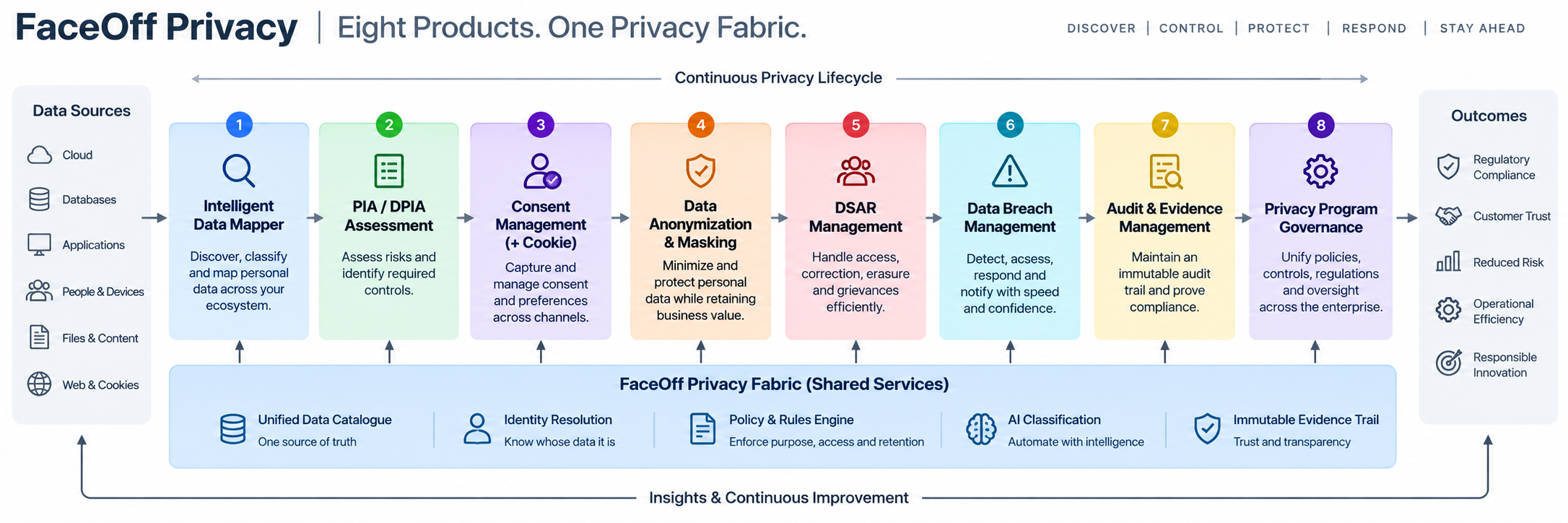
Consent Management, supported by Cookie Management, captures purpose-specific permissions. When consent changes, the shared policy layer connects that decision directly to every system holding the individual's information — so a consent withdrawal flows automatically through governance, data discovery, and evidence management, rather than becoming a manual ticket someone has to chase down.
The next layer turns privacy policy into action. Data Anonymization & Masking protects sensitive information while preserving business utility, while DSAR Management coordinates access, correction, erasure, and grievance requests using the same identity-resolved data map.
When incidents occur, Data Breach Management structures detection, assessment, notification, and closure, while Audit & Evidence Management simultaneously maintains the evidence trail needed to demonstrate what happened and what controls responded.
Finally, Privacy Program Governance provides the enterprise control plane connecting policies, controls, and regulatory requirements — completing a continuous cycle: Discover → Assess → Consent → Protect → Fulfil → Respond → Evidence → Govern, turning privacy from a collection of disconnected compliance tools into one interconnected operating architecture spanning DPDP Act, GDPR, PDPA, CCPA/CPRA, LGPD and PIPEDA.